
Easter of Christ Computus Clock
The first ever orthodox computus clock
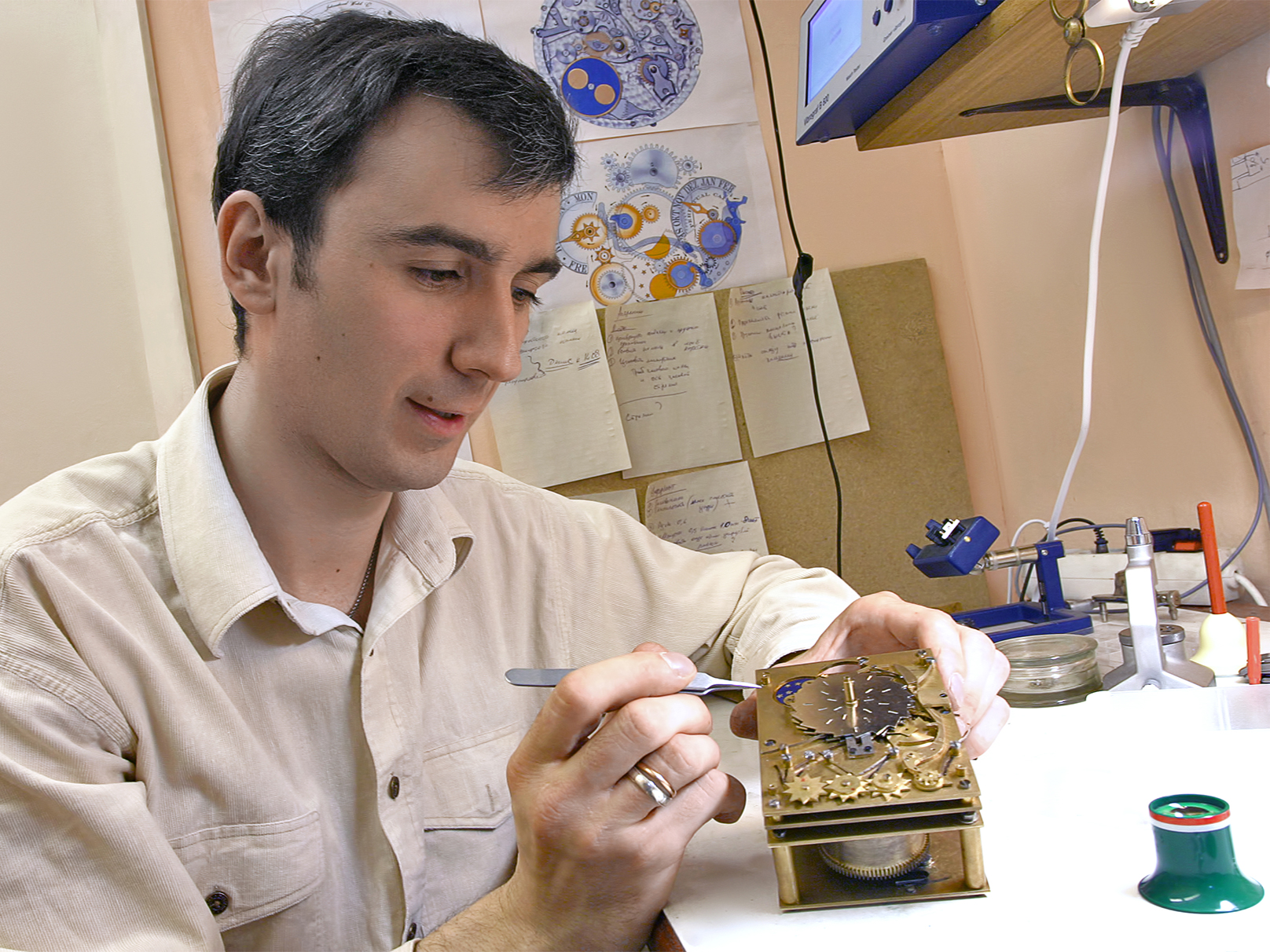
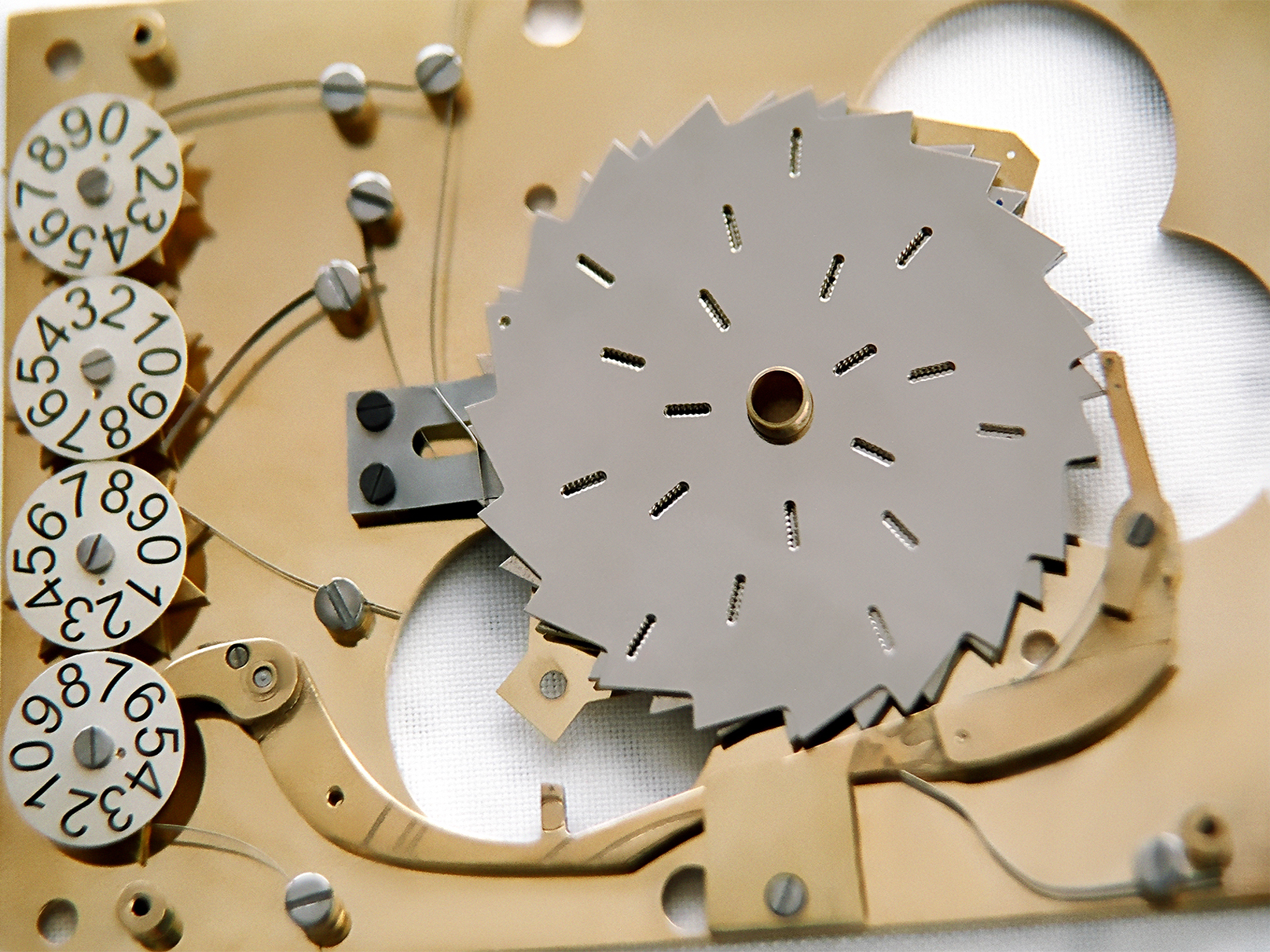
In early 2005, Konstantin Chaykin completed his second tourbillon table clock, the Tourbillon Carriage clock, and considered a more ambitious project in which the basic movement of the tourbillon table clock would be equipped with a fusée-and-chain transmission and a perpetual calendar with a four-digit year display and a 48-month programming disc cam. However, the idea of designing an Orthodox Easter computus, which came out of nowhere and immediately fired Konstantin’s imagination, distracted him from his originally planned project. After some historical research, he discovered that not a single clockmaker had completed the task of realizing this function. Although a more complicated version of a computus based on the Gregorian calendar had already been realized several times, the question of a mechanical computus for the Julian calendar remained unanswered. Chaykin abandoned the Fusée project without any regrets. Compared to exploring the newly discovered terra incognita, it seemed a bit boring, so Konstantin immersed himself in studying the peculiarities of the liturgical calendar of the Eastern Orthodox Church: “On some Orthodox website, I saw a table with the 19- and 28-year cycles of the Julian calendar. I started to develop my own calculation method based on this table, which resulted in a unique algorithm that I kept as simple as possible. In my first Computus clock, the Orthodox Easter date is calculated using two discs, one with 19 teeth and the other with 28 teeth, with the same number of programming holes on each radius. When the programming holes in the two discs match, the corresponding date becomes the date of Easter according to the Julian calendar — one of 35 possible dates from March 22 to April 25 according to the old style.”
Konstantin emphasizes the straightforwardness of his design: “What makes this structure great is its elegance. The computus with hand pointer is easy to read and can be realized in any size – the Easter date is clearly visible. The downside is the energy required to make it all work, as well as the need to design, machine, decorate, assemble and customize three hundred components. The movement of the first Computus clock had to turn two levers once a year, so with two additional programming discs, just a few components were needed.” Today’s view of haute horlogerie suggests that the simplicity of the design should be seen as a weakness; however, from a technical perspective, the simplicity of Chaykin’s first Computus clock was its greatest advantage. Looking at Konstantin’s first Computus clock in terms of the difficulty of the algorithm, the solution must be described as ingenious. He applied for the patent in June 2005 and was granted patent RU2306618 in January 2007. Patent RU2306618 was the first in Chaykin’s series of patents, which totaled 97 in July 2024. It should be noted that since the beginning of his career as an independent watchmaker, he has focused on embodying his own inventions rather than reproducing and reinterpreting inventions and designs of famous watchmakers of the past.
For the Easter of Christ Computus clock, the basic tourbillon movement (the third tourbillon developed by Chaykin) and the perpetual calendar were taken from the aborted Fusée project. The size of the tourbillon movement, which was already completed at the time, dictated the dimensions of the Computus’ programming discs, which led to a display problem — the working area of the display, which could not be more than half the diameter of the dial, had to accommodate the 35 apertures of the programming discs: “My first thought was that it might be a good idea to use a moving eyepiece, but then I realized that would be inconvenient because the owner would have to find a certain point of view and look at the dial at a certain angle to see anything. Of course, I could have built a larger clock or used a backlight, but in the end I decided on a cylindrical lens,” Chaykin recalls. The clock was completed and presented to the Russian public at the Moscow Watch Salon in 2005 and subsequently added to the museum collection of the Konstantin Chaykin Manufacture.

The complications of the Easter of Christ computus clock
(Hours, minutes, and seconds of the mean time are considered to be the basic functions of the movement and are not seen as complications.)
- Computus—mechanical positional indication of Orthodox Easter date according to the Gregorian and Julian calendars.
- Perpetual calendar with automatic adjustment according to the months’ durations and the leap year cycle.
- Date indicator.
- Date indicator.
- Month indicator with leap year cycle indication.
- Four-digit year indicator (up to year 9999).
- Moon phase and age of Moon indicator.
- One-minute tourbillon.
PHOTO GALLERY


