
Luсomorye Clock
Konstantin Сhaykin, master of extraordinary table clocks
Konstantin Chaykin, a prolific inventor and independent watchmaker, devoted much of his time and effort to the development of complicated mechanical clocks. Many modern watchmakers miss the great opportunity to demonstrate their talents in traditional clockmaking, which originated earlier and preceded the invention of the watch.
Lucomorye, a masterpiece of highly complex clock mechanics
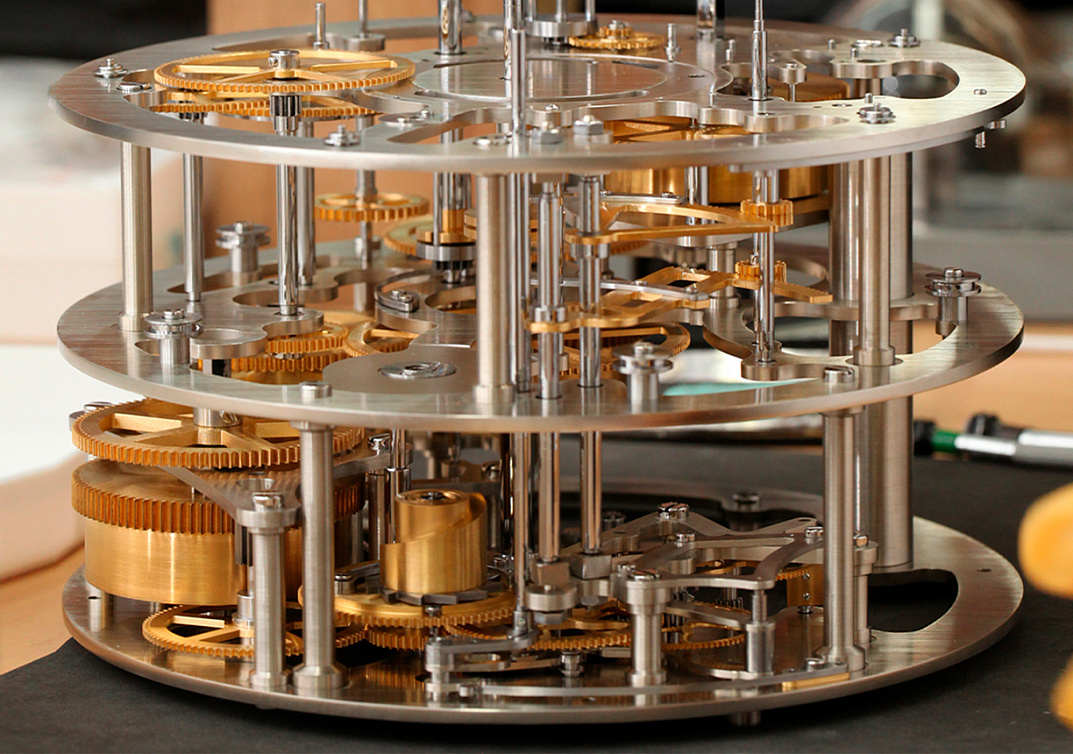
High-quality, highly complicated mechanics are truly enchanting. Konstantin Chaykin meditated while assembling the Lucomorye сlock movement. Elaborately decorated plates and bridges with sharp straight grinding, polished screws and pivots, immaculately cut pillars, disc cams programmed with micrometer precision, the Maltese cross of the Geneva stopwork and what at first glance appears to be a chaotic network of gold-colored wheels. The microcosm of precision mechanics follows its own logic: the clock houses Konstantin Chaykin’s graphic chain hour display, one of the most complicated single-function displays in the history of horology.

Impressive invention
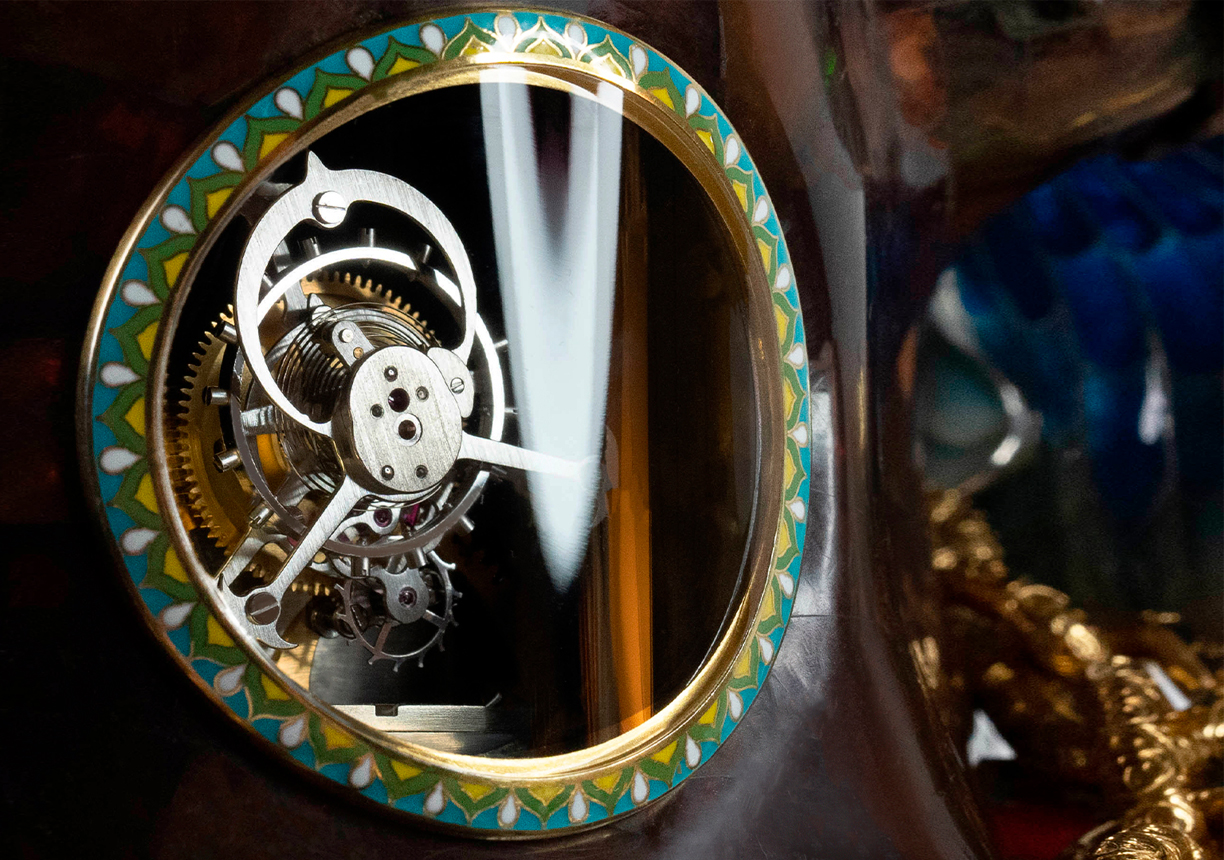
The movement of the Lucomorye clock is based on a construction with four barrels – three of them store the energy needed to drive the graphic chain digital hour indicator, the most complicated hour display of all time, and the fourth barrel is used to drive the tourbillon movement, which measures the time. Its power reserve is 8 days, and the graphic chain hour display is designed for the same duration. The tourbillon retains the characteristic “Alpha” shape (used in all Chaykin tourbillons since 2007), while its construction has been significantly revised: The Lucomorye clock uses a flying tourbillon, which is arranged vertically. It is noteworthy that for the first time in his career, Konstantin Chaykin developed a clock movement that is mainly arranged horizontally, with the exception of a tourbillon – this is one of the distinctive features of the Lucomorye clock.

Movement
Although the caliber TLU.04-0, the movement of the Lucomorye clock, belongs to the category of super complications, it has relatively few indications. However, this is not surprising. Most of the 1119 parts that make up the Lucomorye movement are used in the chain-graphic digital hour indicator. This puts the Lucomorye clock in line with Konstantin Chaykin's other super-complex masterpieces, the Computus clocks, whose orthodox Easter date display has the same feature: to achieve the visually simple function of a single hand, an extremely complicated mechanism of around 300 parts must be used to operate that hand.While the Computus clocks designed by Konstantin Chaykin determine the date of the coming Easter once a year – at New Year, the chain-graphic digital hour indicator of Lucomorye clock works once an hour. Strictly speaking, it is a mechanical computer. It calculates at the end of each hour exactly how the coming hour should be displayed as a Roman numeral from I to XII. This mechanism produces this automatically, without the owner having to do anything. So, it works 24 hours a day, all year round, accompanied by rotation of tourbillon, the most charming complication in haute horlogerie.

Lucomorye, a masterpiece of high jewellery art
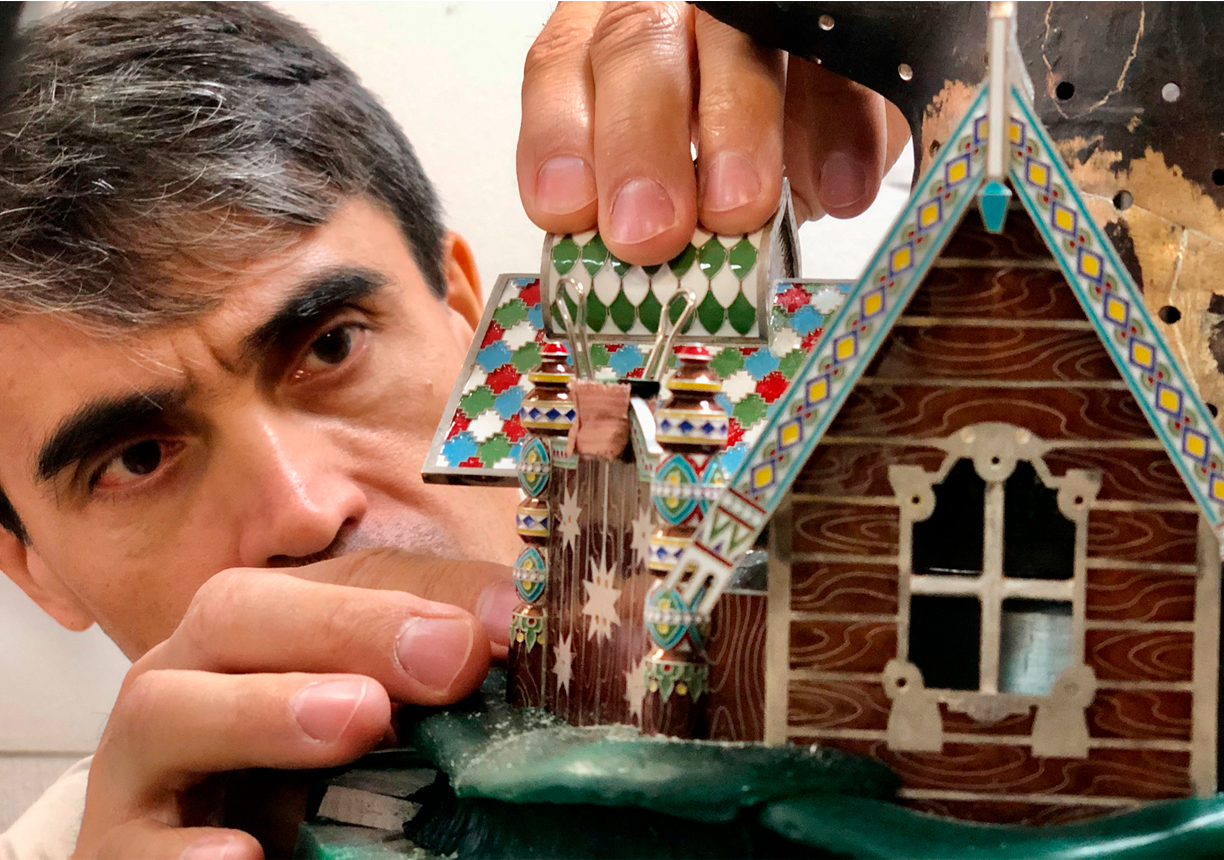
The magical atmosphere in the introduction to Pushkin’s fairy tale poem Ruslan and Ludmila called for a suitable embodiment in the Lucomorye clock, so Konstantin Chaykin decided to ask Ilgiz Fazulzyanov, an outstanding jeweler and founder of the Ilgiz F. jewelry brand, for a collaboration. The reason why Konstantin Chaykin made this decision was the subtle sense of nature in the jewelry, which he discovered at the exhibition “Jewels inspired by nature. Ilgiz F.”, which took place in the Moscow Kremlin in 2016. The ideas of Konstantin Chaykin inspired Ilgiz Fazulzyanov to join the prominent clock project.
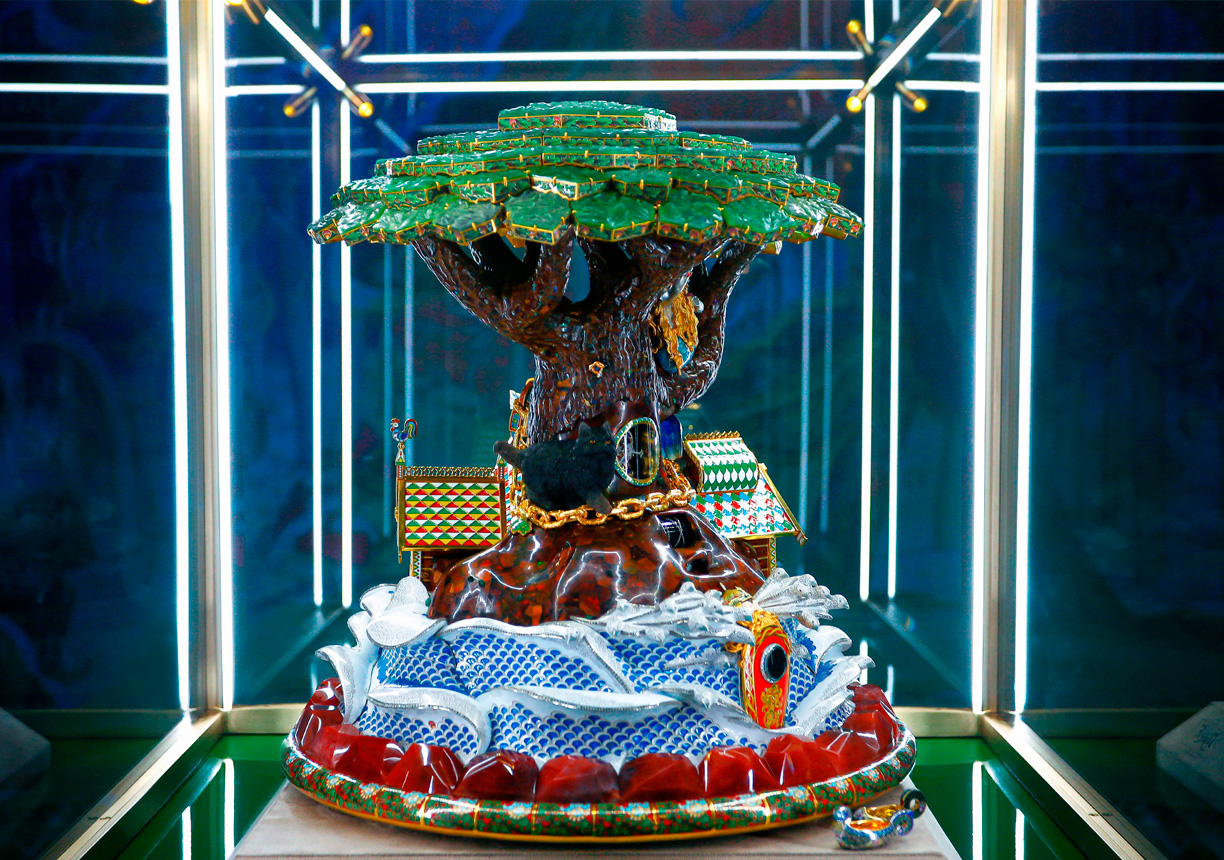
Thanks to Ilgiz Fazulzyanov, the ultra-complicated mechanics of the Lucomorye clock have been given a unique, luxurious and exquisite jewelry design. Ilgiz Fazulzyanov, a famous master of “storytelling” jewelry, quickly found a suitable idea. The feeling of Pushkin’s Lucomorye, including the learned cat, the mermaid, the wizard Chernomor, the oak tree, the hut on chicken legs, the rocky coast and the sea waves beating against it – all this threatened to turn the composition into a collection of disparate elements, a real nightmare for an artist. Ilgiz Fazulzyanov solved this problem by introducing a common visual rhythm. According to his plan, the rhythm can be traced both in the faceted stones fighting the waves and in the crown of a marvelous oak tree divided into many panels – all with the same outlines. The base of the oak crown is a spatial structure consisting of many elements resembling oak leaves, to which jade panels with carved leaf outlines are attached. Each plate is fixed in castes which are decorated with oak leaves and acorns made using the hot cloisonné enamel technique. Another element with the same rhythm is the oak trunk decorated with Australian boulder opals and Ethiopian fire opals. The multicolored reflections and the way the light falls on the opals lend the entire composition an air of wonder and mystery.
Ilgiz Fazulzyanov had to use all his experience to realize his plan. But the work proved to be extremely difficult, even for his talent. Problems arose firstly from the complexity of the composition and secondly from the fact that many components had to be used. The unusually large dimensions of the parts required the adaptation of seemingly tried and tested production methods.
Nevertheless, the inevitable technical problems were solved and the Lucomorye clock, a masterpiece of high jewelry and haute horlogerie, was finally completed. It took more than six years to complete, and the result is impressive.
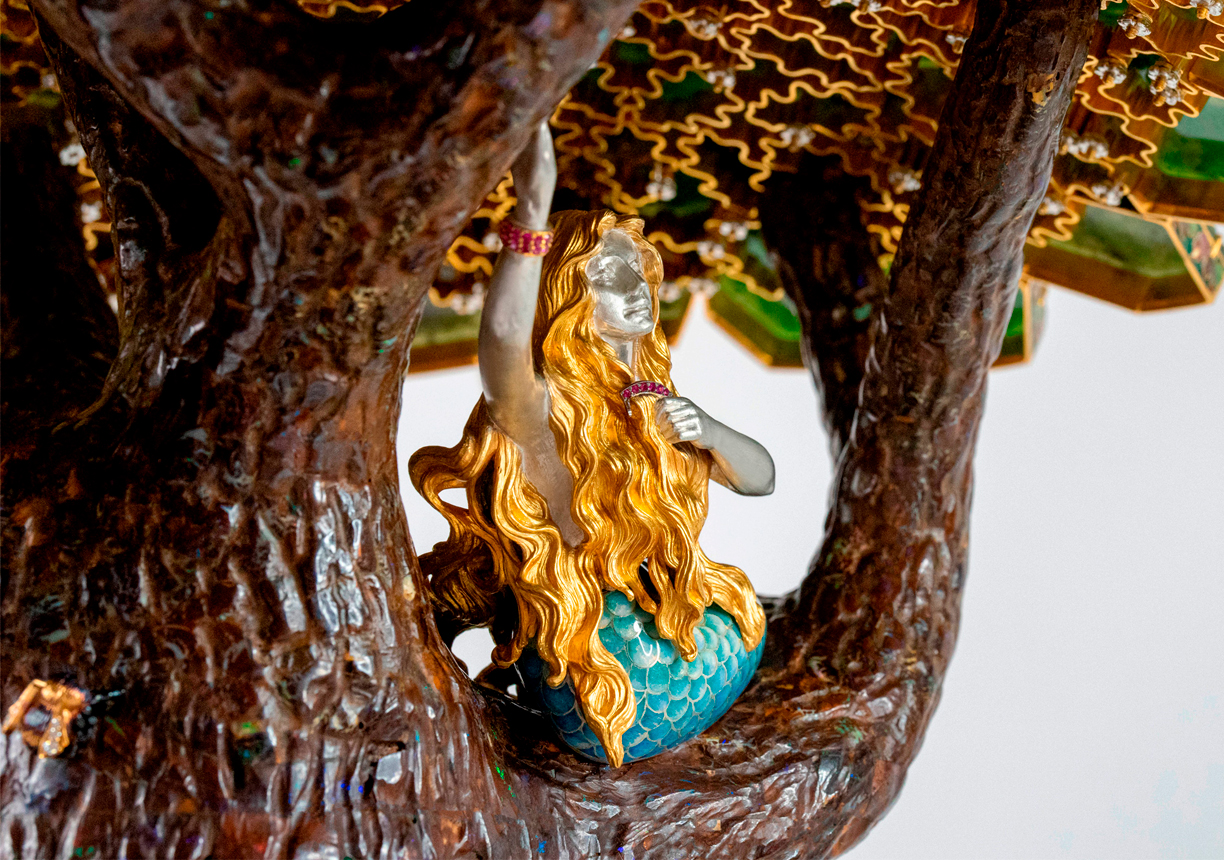
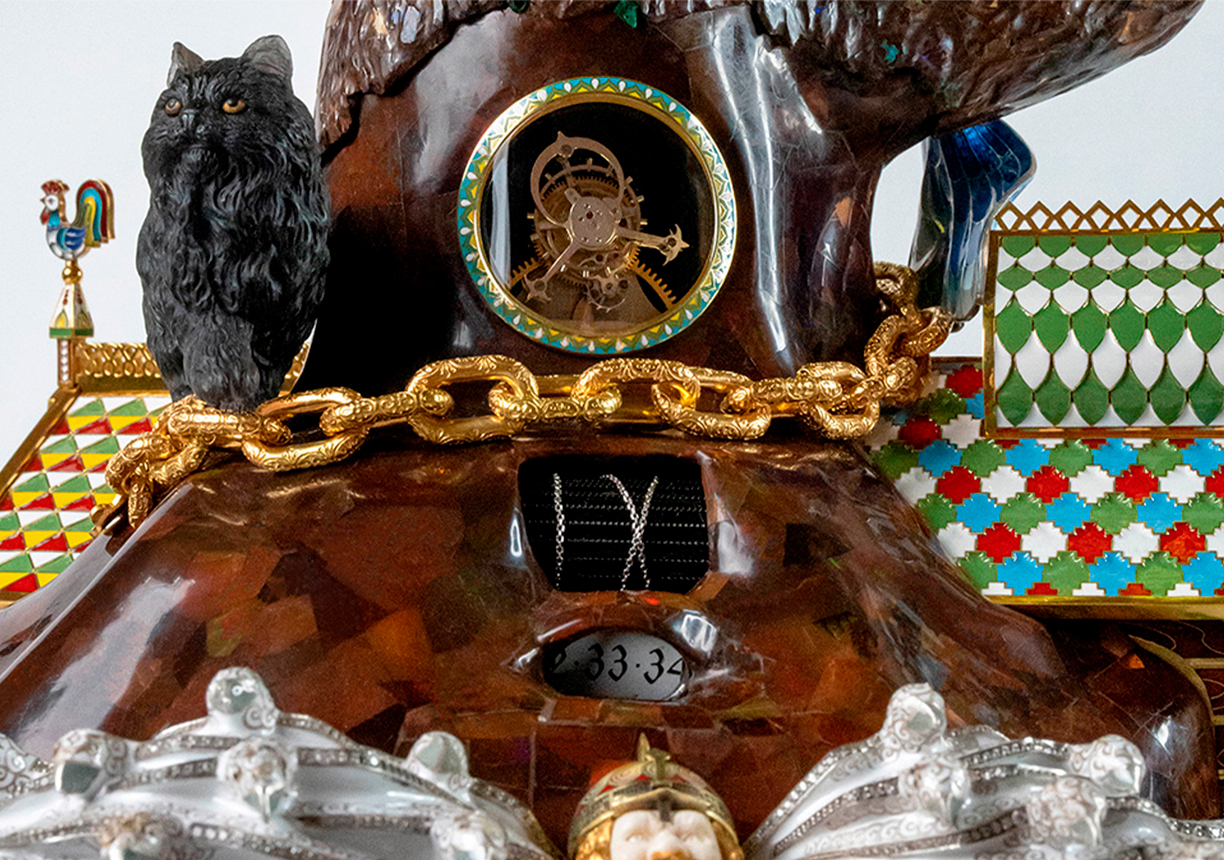
Thanks to Ilgiz Fazulzyanov, the ultra-complicated mechanics of the Lucomorye table clock received a unique, chic, and exquisite jewelry design. Ilgiz Fazulzyanov, a famous master of jewelry "with the story", quickly managed to find a successful idea that completed the composition. The image of Pushkin's 'Lucomorye', including the learned Cat, the mermaid, Chernomor, as well as the Oak, the hut perched on chicken legs, stones, and the sea waves smashing against them, created by the master, threatened to turn the composition into a set of disparate elements - a real nightmare for an artist. Ilgiz Fazulzyanov solved this problem, which is considered to be common for all multi-figured compositions, by introducing a unifying visual rhythm. According to his plan, the rhythm can be traced both in the lower ridge of faceted stones fighting the waves, and in the crown of a wonderful oak, which is broken into many plates - the outlines of the same stones are unmistakable. The base of the crown is a spatial structure of many elements that resemble oak leaves, jade plates with carved leaf contours attached. Each plate is fixed in castes, which are decorated with oak leaves and acorns, made in the technique of hot cloisonné enamel. Another element with the same rhythm is the oak trunk, decorated with Australian boulder opals and Ethiopian fiery opals. Multi-colored reflections and the way light falls on opals give the whole composition a sense of miracle and mystery.
Ilgiz Fazulzyanov had to use all his experience to bring his plan to life. And yet, the work proved to be extremely difficult even for his talent. Problems arose both because of the composition's complexity, and also because it was necessary to use many components, the unusually large size of which required the adaptation of seemingly tried and tested production methods.
Nevertheless, talking is one thing, doing is another, the inevitable technical problems have been solved, and the Lucomorye clock, a new masterpiece of jewelry and Haute Horlogerie, has finally been completed. It took more than six years to finish, and the result is impressive.
PHOTO GALLERY


