
Northern Computus Clock
Northern Computus Clock – a dedication to the northern capital of Russia
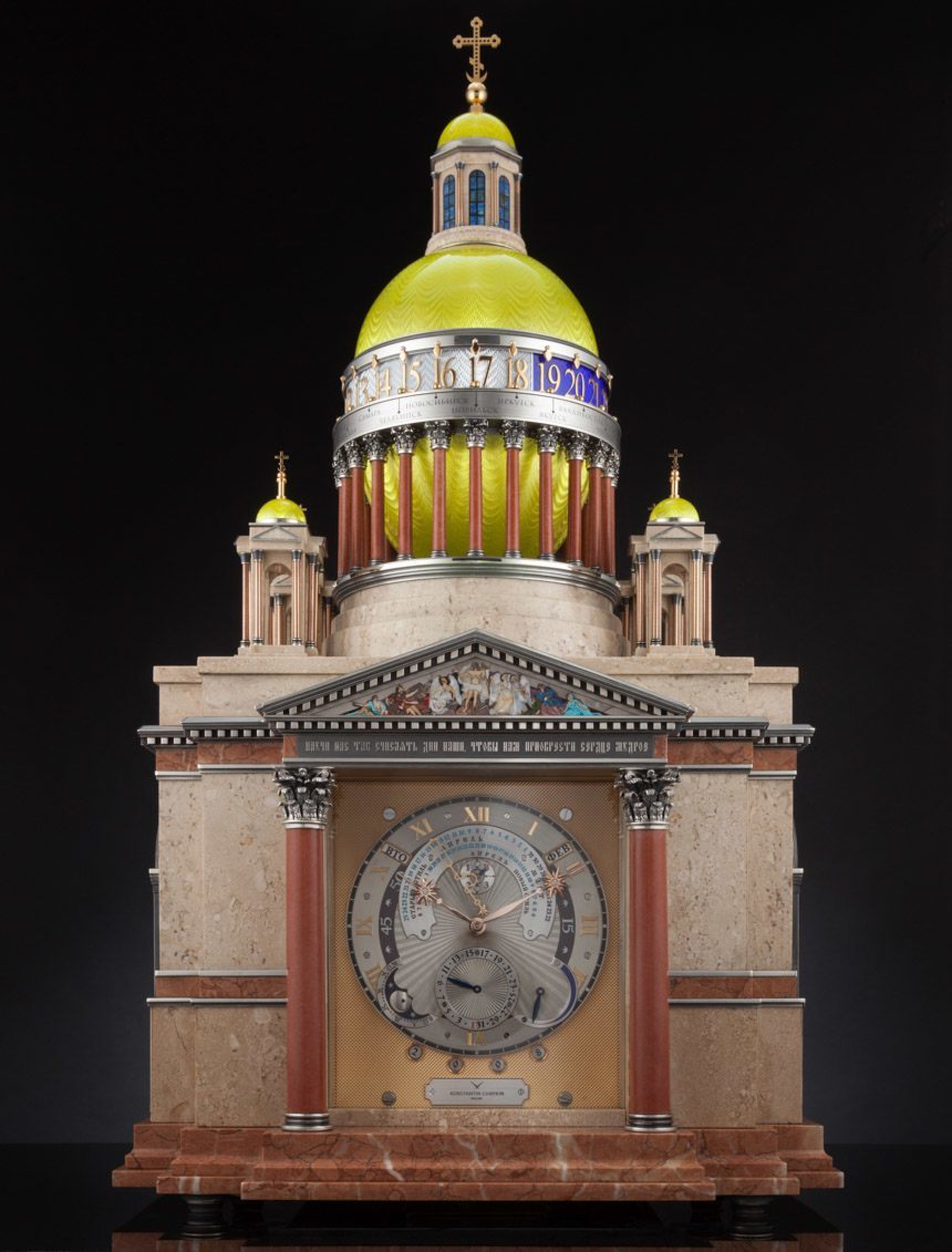
The super-complicated astronomical Northern Computus clock was named by Konstantin Chaykin in honor of his hometown of St. Petersburg, which is often referred to as the northern capital. In its design, the characteristic features of the architecture and decor of the city’s St. Isaac’s Cathedral, one of the most famous historical symbols and tourist attractions of the city on the Neva, are unmistakably recognizable.
The decoration of the Northern Computus clock is rich and varied, just like the architectural jewel which inspired it. Marble plays the main role in the decoration of the clock, the famous red granite column of St. Isaac’s Cathedral is reproduced in jasper, the sculptural capitals are made of silver, as are the roofs of the porticoes and the dome, which are decorated with guilloches and a translucent green and intense yellow enamel. The sides of the clock case are decorated with panels in Florentine mosaic technique showing the stained glass image of the Risen Christ and the mosaic image of the Archangel Michael from the high altar of the church.
The original reliefs of the pediments of the northern portico (Resurrection of Christ) and the southern portico (Adoration of the Magi) are reproduced on the pediments of the front and back of the case using the Florentine mosaic technique. The same technique was also used for the side walls, on which the stained-glass image of the Risen Christ and the mosaic image of St. Michael the Archangel from the main altar of St. Isaac’s Cathedral are depicted.
The dome of St. Isaac’s Cathedral, one of the most magnificent buildings in the world, is covered with gilded copper plates. Konstantin Chaykin interpreted this architectural detail in a special way for this Northern Computus clock: He imagined the main dome as an Easter egg, decorated with a guilloché relief pattern and covered in gold-colored hot enamel. Konstantin Chaykin wanted the clock to express the idea and symbolism of Easter. This is why the dome is in the shape of an Easter egg, which is interpreted as a symbol of resurrection in the Orthodox tradition, as giving painted eggs at Easter is an age-old tradition that is still practiced today.
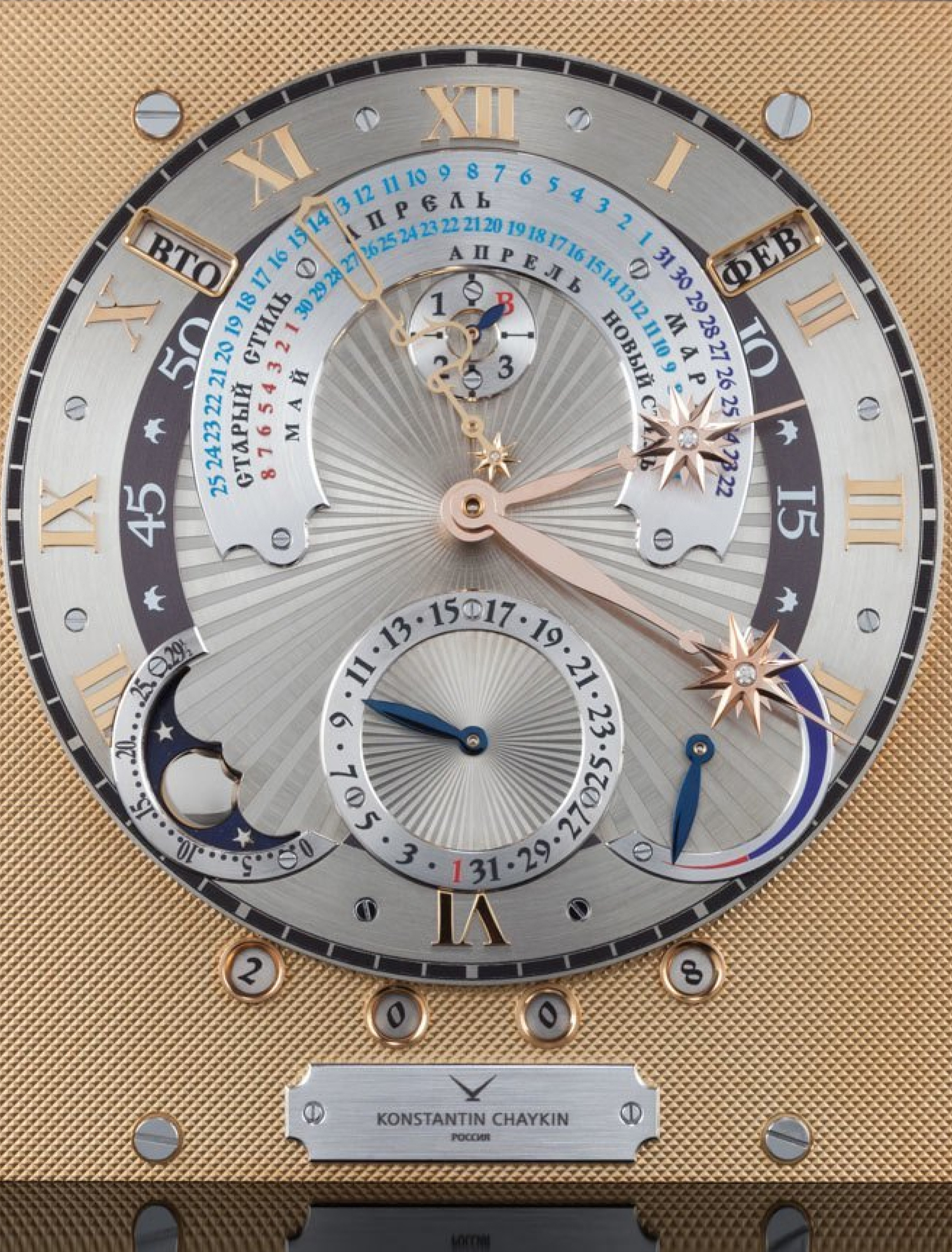
The colonnade of St. Isaac’s Cathedral, which frames the dome of the Northern Computus clock, happens to have exactly 24 columns, which is why Konstantin Chaykin chose it as the basis for the circular displays of world time and the Russian time zone system. On the main dial of the clock there is a scale showing the date of Orthodox Easter in the current year. At the same time, it is possible to calculate the date of Easter according to both the old and the new calendar. The changeover of this display to the new Easter date takes place once a year, on the night of December 31st to January 1st. On the back of the movement is a planisphere with a map of the night sky as seen from St. Petersburg, as well as information on the time of year, sidereal time and the equation of time. The latter is used to show the difference between the true solar time and the mean solar time, which is caused by the Earth’s elliptical orbit and the 23 degree tilt of its axis.
The movement of the Northern Computus Clock, in which 16 complications are built in, consists of 1375 parts, which is why it was considered the most complicated clock ever made in Russia when it was completed. In terms of complexity, it was only surpassed by Konstantin Chaykin’s next super-complicated masterpiece – the Moscow Computus clock.


Movement
The caliber TCO.03-0 of the Northern Computus clock was developed by Konstantin Chaykin and equipped with a mechanical complication that displays the date of Orthodox Easter as well as 15 other complications. The movement was manufactured entirely in the Konstantin Chaykin Manufacture according to the standards of haute horlogerie. Traditional craftsmanship techniques are used to refine the components: fine straight and circular grinding, hand-polished bevels, engravings, polished screw heads, ball polishing of the pivots, nickel plating and gold plating. A special feature of the movement is the “Alpha” tourbillon design, a signature of Konstantin Chaykin’s tourbillons, as well as two dials on two sides of the case.
Caliber: TCO.03-0, key wound, made by Konstantin Chaykin Manufacture
Power reserve: 10 days

The complications of the Northern Computus Clock
(Hours, minutes, and seconds of the mean time are considered to be the basic functions of the movement and are not seen as complications.)
- Computus—mechanical indication of Orthodox Easter date according to the Gregorian and Julian calendars.
- Perpetual calendar with automatic adjustment according to the months’ durations and the leap year cycle.
- Date indicator.
- Day of the week indicator.
- Month indicator.
- Four-digit year indicator (up to year 9999).
- Leap year cycle indicator.
- Moon phase and age of Moon indicator.
- Equation of time indicator.
- Planisphere with the St. Petersburg starry sky map.
- Sidereal time indicator.
- Seasons indicator.
- One-minute tourbillon.
- 24-hour world time indication with local time indication in 11 Russian time zones.
- Power reserve indicator.
- Mechanism of computus module direct drive from a ratchet wheel.

A mechanical Complication to solve complicated matters
The Northern Computus clock, the third Computus clock by Konstantin Chaykin, is based on the complication he invented to display the Orthodox date of Easter. Easter is a moveable feast. For someone who is not familiar with such matters, the date of Easter, which changes every year, seems mysterious and unpredictable, as the calculation of this date requires special knowledge and the consideration of many rules.
The Metonic cycle, the solar cycle, the indiction, the Julian and Gregorian epacts, the Julian and Gregorian Dominical letters, the great indiction, the date of the Paschal full moon… these are the basic concepts used to calculate the date of Easter. Konstantin Chaykin first studied the extremely complex algorithm for calculating the date of Easter in detail, then developed his own calculation method, had it patented and used it as the basis for his super-complicated mechanism for automatically displaying the date of Easter – it alone consists of more than 300 parts.
PHOTO GALLERY


