
ThinKing prototype 2
The Konstantin Chaykin’s new ultra-thin mechanical wristwatch
In the history of watchmaking, there have been several periods in which watchmakers have been seriously engaged in radically reducing the thickness of watch movements and thus also of watches – we call this the race for the thinnest watches. We are witnessing a race that continues to this day.
In 2024 a new player enters the race– the independent watchmaker Konstantin Chaykin.

1.65 mm
This is a rare case where a number is sufficient for the heading. 1.65 mm – that is the thickness of the new ultra-thin mechanical wristwatch ThinKing, conceived and developed by Konstantin Chaykin. The story of this development began a long time ago: one fine day, around twenty years ago, Konstantin Chaykin came across an old ultra-thin Bagnolet pocket watch caliber with cylinder escapement, signed Aug.
Golay Leresche à Genève and dating from the mid-19th century
This movement is about one millimeter thick, not counting the height of the hour and center wheels. I held it in my hands and they offered to buy it. Now I regret that I didn’t say yes, because the movement was made almost two hundred years ago – given the development of watchmaking technology at that time, that really is an achievement for a watchmaker.


If such an outstanding example of watchmaking craft was created almost two centuries ago, why shouldn’t a modern watchmaker, armed with the advantages of modern technology, try to create something similar?
At the time, this logical thought did not inspire Konstantin Chaykin, a budding independent watchmaker, to create an ultra-thin watch as he was busy with other projects. Today, however, he admits that he still lacked the experience and knowledge of materials to complete the development at an appropriate level.
This project, like many others in Chaykin’s career, came about by chance:
This story began when I once showed a client a project of my super-complicated wristwatch. He replied that of course it was all very cool, but there were probably more difficult tasks, such as: Can I make an ultra-thin watch? I had been interested in ultra-thin movements for a long time and said I would think about it. That was in 2023. Of course, I had already looked into this subject before, in particular I knew all the masterpieces created before , but I hadn’t looked into it any further. When I was confronted with this task, I started to take a closer look at what it actually is – the ultra-thin watch. Of course, the first thing that came to mind was Auguste Golay’s millimeter-thick movement – sometimes moments from the past suddenly become relevant again. As for my current ultra-thin watch project, I initially considered many possibilities and dedicated an entire Moleskine to finding technical solutions.

Definitely a wristmon
First of all, Konstantin Chaykin decided that his ultra-thin watch would definitely be a wristmon. He assumed that Swiss watchmakers would most likely continue to propose new ultra-thin watches, and in this situation he always has the advantage of a unique design known to the entire community of watch connoisseurs around the world. He was also attracted by the idea of giving such a purely technical project as an ultra-thin watch a direct emotional coloring – and this is precisely the undeniable advantage of the Wristmons collection he created.
For this reason, the movement of the ThinKing watch is modeled along the lines of a joker-indication design, i.e. with separate hour (left) and minute (right) displays, which form the eyes of the character. While in the original Joker watch and many other wristmons the smile of the character is the moonphase turned upside down compared to the standard configuration, in the new ultra-thin ThinKing watch the role of the smile is taken over by the brand logo engraved along the arc on the top cover of the watch due to the absence of such a display. Thus, the ThinKing, the new ultra-thin model in the Wristmons collection, has received a double dial protected by two 0.35 mm thick sapphire crystals, instead of the usual full dial, which worsens the situation with the rigidity of the ultra-thin watch.
The practicality of the ultra-thin watch
The master devoted his greatest attention to another problem: how to make an ultra-thin watch, less than two millimeters thick, practical and comfortable. The solution was unexpected and unprecedented: an external carrier case equipped with mechanisms needed to wind the ultra-thin watch and adjust the hands. In addition, the external case is equipped with an automatic winding system that is attached to the ultra-thin watch when it is placed in the external carrier case. In this way, the ultra-thin watch is wound automatically and the owner only has to hold the external case with the ultra-thin watch on the wrist. Konstantin Chaykin sees this idea as a further development of the concept of the “symbiotic” watch and clock concept by Abraham-Louis Breguet (Pendule Sympathique), but with one crucial difference: Breguet’s “symbiotic” design winds the pocket watch inside the clock and adjusts its hands at night when the pocket watch can not be in use, whereas Chaykin’s “symbiotic” watch system works when it is worn on the wrist. Of course, the watch also remains very attractive in its outer casing. The external case design, also created by Konstantin Chaykin, makes for a comfortable wearing experience, and the watch looks stunning in its outer case. Like every other wristmon from Chaykin.
In addition, the external carrier case of the ThinKing watch, based on the idea of Konstantin Chaykin, will help solve perhaps the biggest problem of ultra-thin watches – the low rigidity of their case. Of course, watchmakers working with ultra-thin watches solve this problem in one way or another. Two main methods are used. The first is the use of particularly strong materials – according to Konstantin Chaykin, the best material available for this purpose is tungsten carbide. Secondly, stiffening ribs are provided in the construction of the case and movement. However, these are formed almost automatically when the caseback of the watch is used as the plate of the movement and the appropriate recesses are milled into the plate to accommodate the necessary components. This has been a standard solution for super-thin watches since the time of Swiss watchmaker Philippe-Samuel Meylan, who invented such a design in the 1830s or 1840s.
Konstantin Chaykin used both methods in the development of the ThinKing watch. In particular, he uses a special stainless steel with a very high rigidity as the base material, which has which is best suited to an ultra-thin watch. Additional protection, albeit indirect, is provided by the strap, which was specially developed for this watch.
Nevertheless, Konstantin Chaykin believes that the external carrier case he has developed provides a useful guarantee that ultra-thin watch he developed will serve its owner for a long time, while he will always have the opportunity to enjoy the ultra-thin wristmon on his wrist. In all circumstances that can be dangerous for an ultra-thin watch, Konstantin Chaykin recommends the use of the external case, especially since the ThinKing watch in an external carrier and protective case with a thickness of only 5.4 mm, on which the ThinKing watch is placed, falls into the category of ultra-thin watches. To emphasize the uniqueness of this invention, Konstantin Chaykin decided to give the external carrier case of the ultra-thin watch its own name – PalanKing, which the master came up with in reference to the name ThinKing. As is easy to see, the name PalanKing is derived from the word “palanquin”, which refers to a means of transportation for particularly discerning persons, to which the new ultra-thin wristmon undoubtedly belongs.
The development of an ultra-thin wristwatch is impossible without inventing it
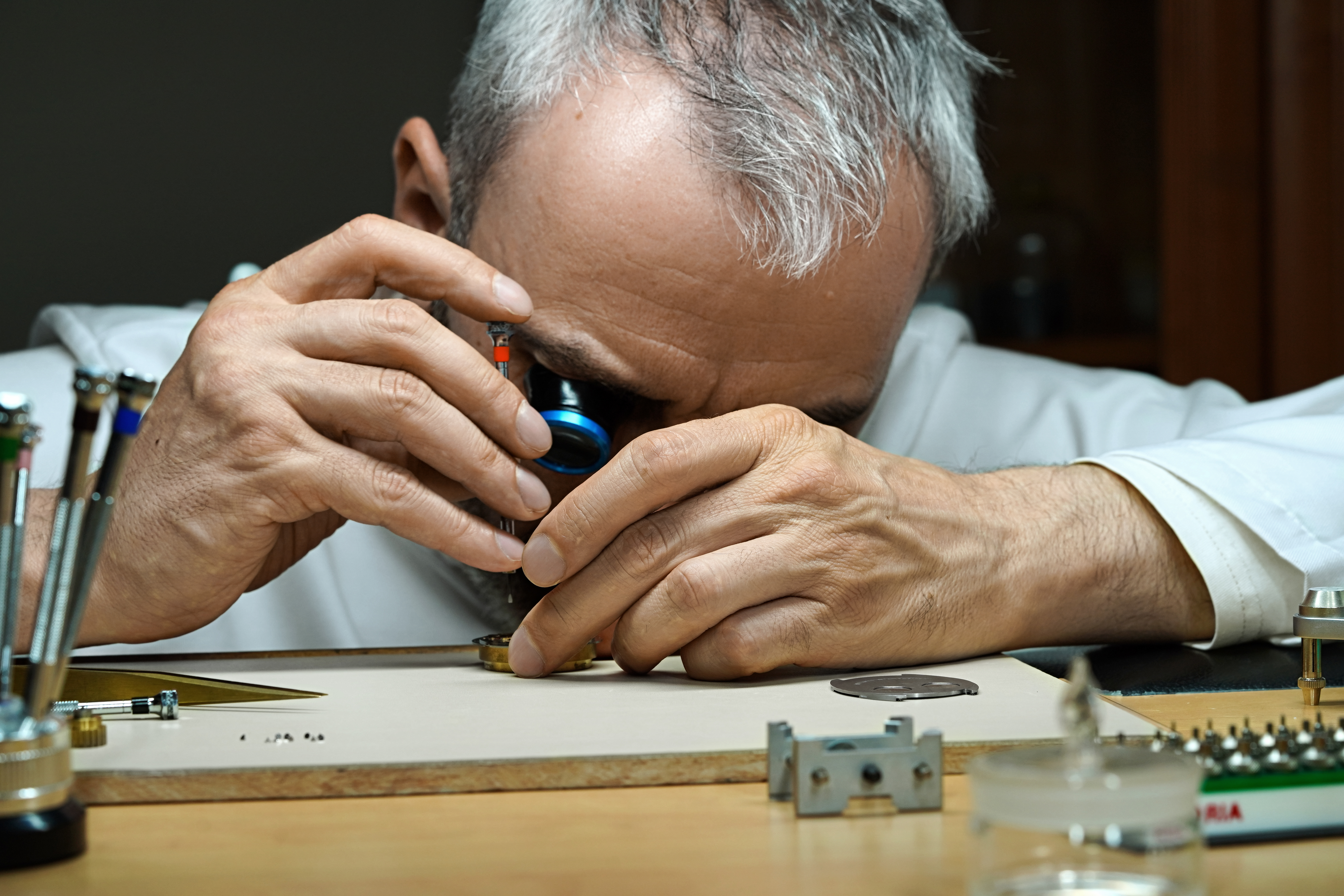
When it came to the technical aspects of the project, Konstantin Chaykin relied on the information he had gained from a thorough study of other watchmakers’ experiences – this helped him to identify problems before the design phase and find his own solutions. There were some groundbreaking solutions: Based on the results of the development, Konstantin Chaykin applied for three patents describing the designs of an ultra-thin winding barrel, a double balance wheel, and – what a surprise! – special strap for an ultra-thin watch. The first two technical units were crucial in reducing the thickness of the ThinKing watch, while the third invention makes it possible to make the use of the ultra-thin watch safer for the watch itself. However, the invention of the ultra-thin wristwatch was by no means limited to this.
“My original task was to design the entire movement mainly in one, two or at most three levels, no more. To be honest, this task didn’t cause me any major problems. On the contrary, it was a pleasure to put it together like a puzzle. As with any good puzzle, I had to tinker, look for non-trivial solutions, choose the best options and calculate the energy flows,
Chaykin recalls. The entire gear system, including the motion work, is built on two levels. Of course, there are two more levels – the mainplate and the bridges. Thanks to Chaykin’s invention, the winding barrel is actually made on one level, although it takes up all the available space under its bridge – the energy stored in it must be maximized.
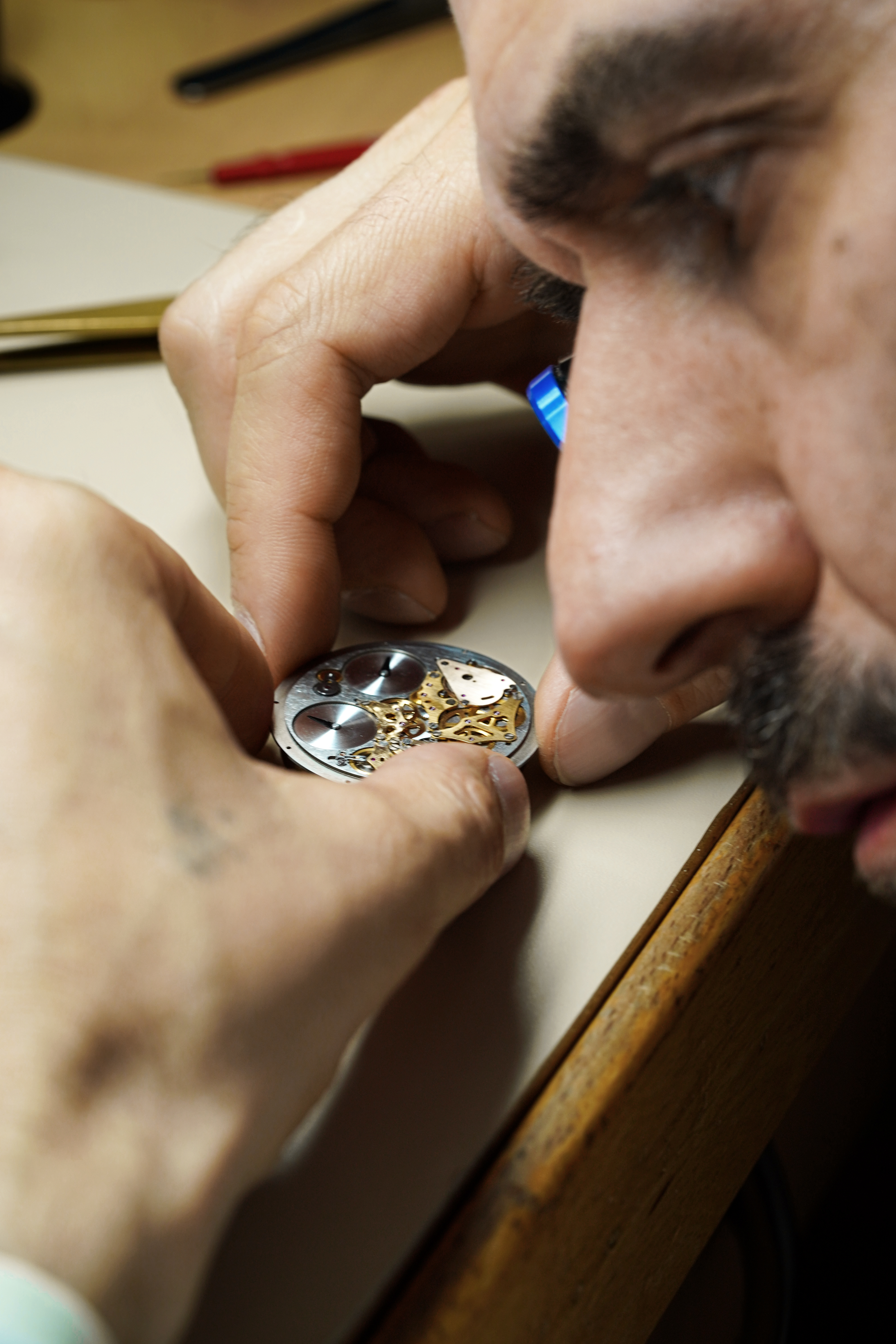
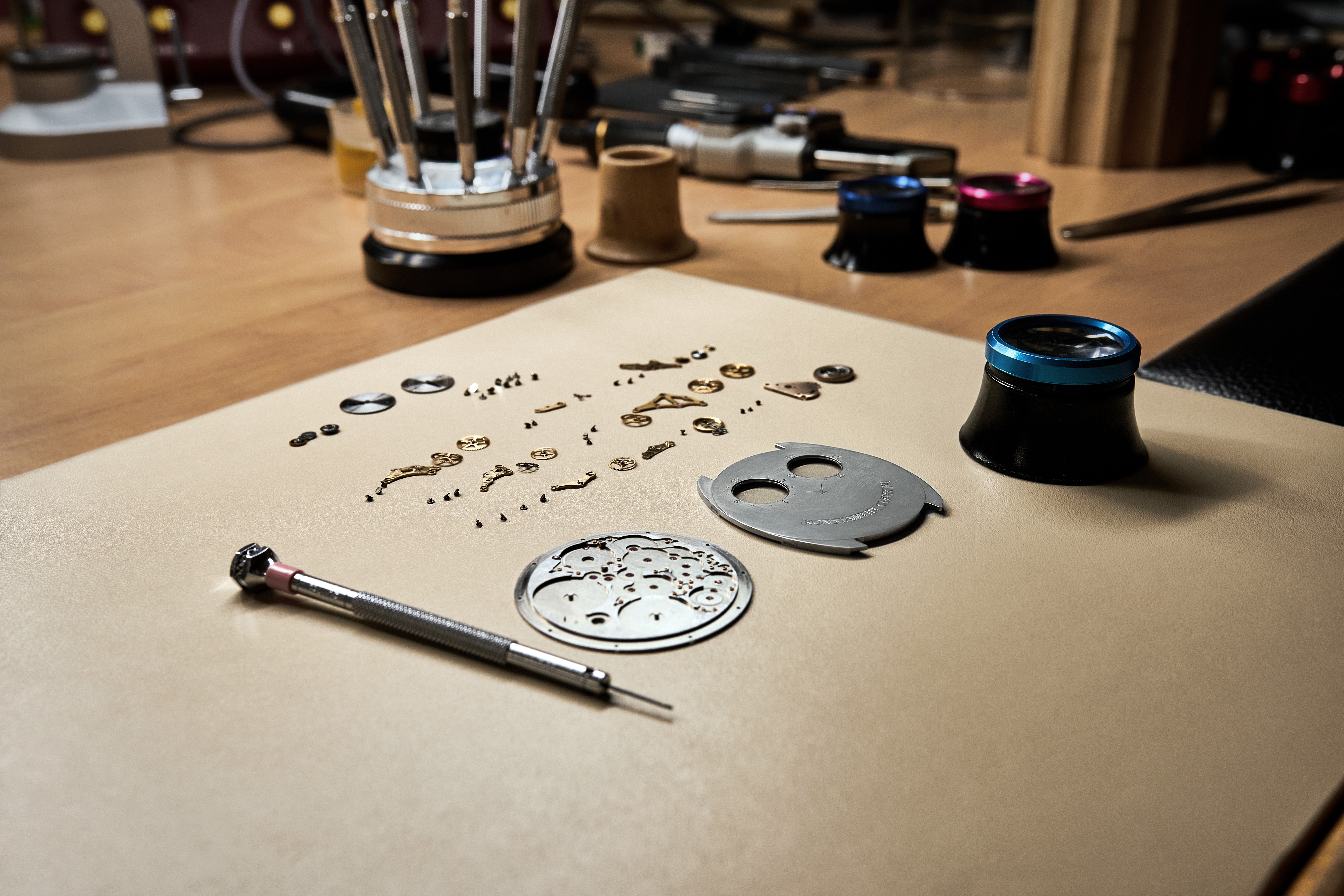
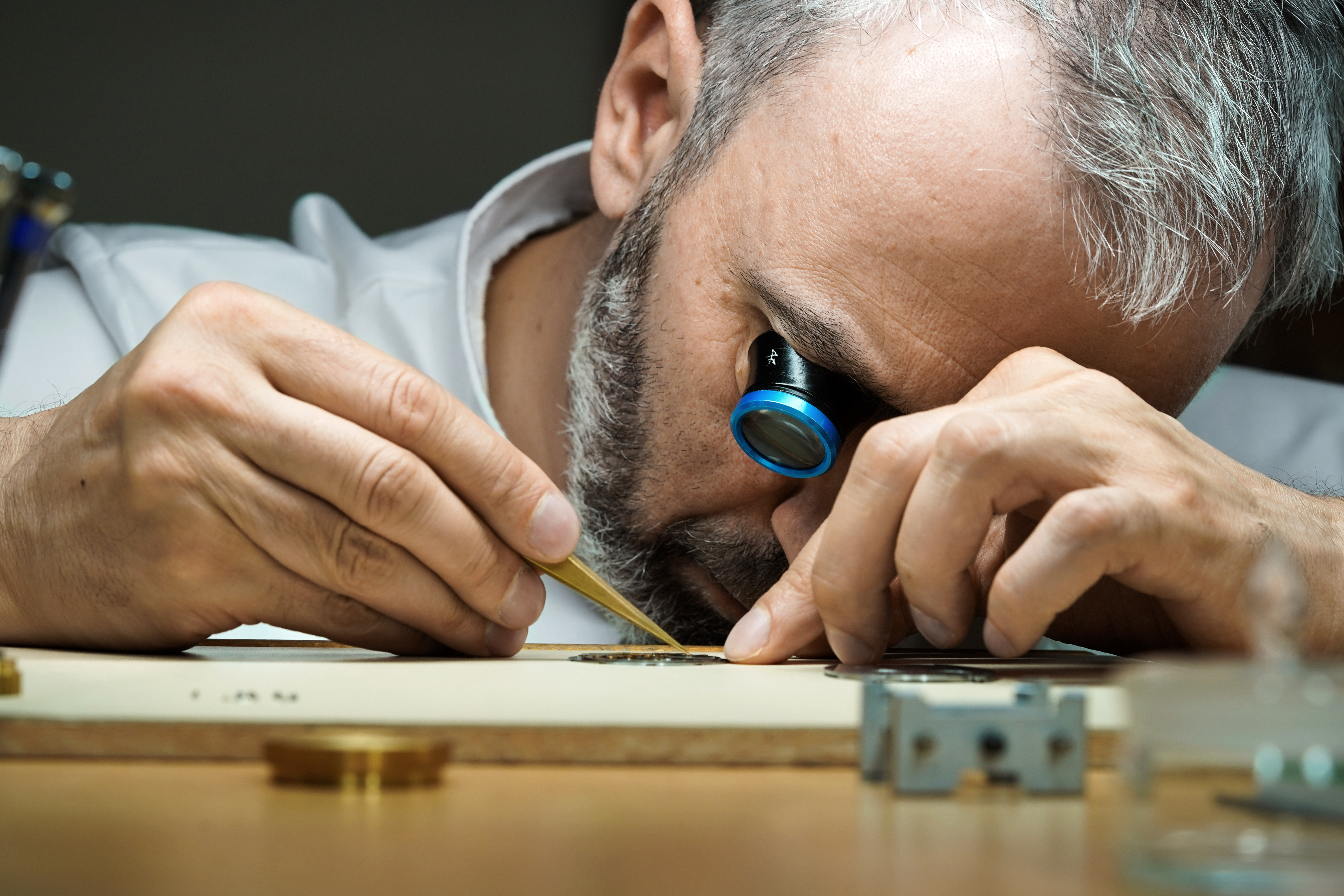

The classic design of the winding barrel is rarely analyzed from the point of view of reducing the thickness of this part of the movement. Konstantin Chaykin invented a very thin mainspring barrel for the ThinKing watch and at the same time created an unexpectedly beautiful design with a pawl and spring built into the barrel-arbor:
“After studying the excellent design of the Richard Mille RM UP-01, I realized that it was possible to completely dispense with the ratchet wheel and the cover of the mainspring barrel. The result is our masterpiece: the mainspring barrel has no covers, and at the same time everything functions stably. The winding mechanism with pawl and flat spring is integrated into the barrel-arbor, making it possible to accommodate a good mainspring in a phenomenally thin volume. For the mainspring barrel, we ground down a mainspring that we had in stock to the required thickness and thus achieved a power reserve of 32 hours, which is quite a reasonable level for a self-winding watch.”

The double balance is one of Chaykin’s ingenious inventions. While there are precedents for the use of double balances connected by teeth on the edge, never before has such a design been used in an ultra-thin watch. As with all things ingenious, the idea is simple. One of the problems in designing an ultra-thin movement is to avoid multi-level structures. Ideally, only two levels should be used, as the gearing of the watch requires wheels that mesh with pinions. So it should have two levels, less is basically impossible.
“The gear train of the ThinKing watch is built on only two levels, the mainplate of the movement is the caseback, the wheels are mounted under the bridges as usual. I did not experiment with mounting the wheels on ball bearings without bridges, as was the case with the ultra-thin movements developed by Swiss watchmaker Pierre Mathys for the Jean Lassale brand in the 1970s, because such a construction, based on the practical application of his calibers, proved not to be reliable enough – all the brands that initially wanted to experiment with it gave up.”
The balance wheel unit is multi-level, because it has a balance rim – that’s one level, a hairspring – that’s the second level, and in a Swiss lever escapement there are two more levels – an impulse jewel and a safety device, the so-called dart, which makes a total of four levels if you don’t count the mainplate and the bridges, as usual. Konstantin Chaykin, who uses a double balance wheel, omits one level by distributing the functions over two balance wheels. The first balance works together with the lever, and the hairspring is installed on the second balance – this is the core of Konstantin Chaykin’s invention. At the same time, the levels of the impulse jewel and the safety device can be brought as close together as possible, as there are no moving parts.

Konstantin Chaykin has once again proven his ability to invent straps for his watches, which is rare in the industry. The strap of ThinKing watch is not purely decorative, which has been the focus of the straps he has designed for some of his wristmons. This is a very special strap. Its peculiarity is that it transfers unwanted stress from the case to a pair of flexible titanium supports and two elastic inserts sewn inside the strap. If a force occurs that could be dangerous for the watch – shocks, bending, etc. – a small part of this force is transferred to the case, while most of it is absorbed by the elastic elements of the strap.

Konstantin Chaykin believes that the main problem in the development of ultra-thin watches is the materials:
“The problems arose when I began to solve a number of other important issues. The first of these was the question of rigidity. From the beginning, I wanted to make the watch a tenth of a millimeter thinner than the Richard Mille watch, which means my goal was 1.65 mm. We designed a case with a special geometry that has a labyrinthine structure inside and a minimum caseback thickness of 0.3 mm, and then tested the project with a program that calculates deformations. We examined the stiffness and deformation of the watch case under various loads. It turned out that tungsten carbide naturally showed the best performance among the more or less common materials under a moment load of up to 30 kg. However, it is quite possible that the use of sapphire or diamond will give better results. I am considering this possibility, but it seems difficult to realize because the technology to process these materials is lacking. Unfortunately. Nevertheless, we decided to build prototypes to test the design with conventional metals. I initially built two models. The first model, ThinKing Prototype 1, is made of annealed brass – a very stable material. This allowed me to literally feel the ultra-thin watch of my own design with my own hands and test all parts of the design. The case of the second model, ThinKing Prototype 2, which is very close to the finished watch, is made of special stainless steel. In my opinion, this is a very good solution because this material offers a sufficient degree of hardness without which it makes no sense to make an ultra-thin watch.”
The ThinKing Prototype 2 watch is therefore made of a special stainless steel whose hardness is sufficient to allow the watch to be worn like a normal watch. By using this material, the risk of it being accidentally damaged when the case is bent is minimal. To further reduce this risk, Konstantin Chaykin played it safe and developed a special leather strap with elastic inserts and flexible titanium supports. These limit the additional bending force that can, for example, unintentionally act on the watch during use.
The ThinKing Prototype 2 watch case consists of two parts. Technically, it is a monocoque with a monolithic caseband and caseback, while its lower part is used as part of the movement – it takes over the function of the mainplate. The upper cover of the watch case is solid, which also contributes to increased strength. The time is displayed on two separate dials – this is an obligatory design feature of every wristmon, and in the ThinKing Prototype 2 watch it allows to minimize the area of the crystals. Each of the two crystals is 0.35 mm thick and has a diameter of 10.4 mm.
Additional protection for the ThinKing Prototype 2 watch is provided by the external case carrier specially developed for it by Konstantin Chaykin. In addition to the purely mechanical protection of the ultra-thin watch inside, it also offers easy handling. The lack of practicality and convenience is one of the most common problems with ultra-thin watches. Their designers suggest using either a special key or a winding crown in the form of an elongated crossbar or two separate flat wheels for winding and adjusting the hands. All this is anything but practical. That’s why Konstantin Chaykin decided to offer a really useful solution – an external case carrier that fulfills both functions and makes using the ThinKing watch very convenient.
Unplanned bonus
Although Konstantin Chaykin did not set himself such a task, together with the development of an ultra-thin design, he has succeeded in creating an ultra-light watch, one of the lightest watches in the world: the weight of the ThinKing watch is only 13.3 grams without the strap.
To Geneva!
In spring 2024, many pieces of the puzzle fell into place. Konstantin Chaykin began manufacturing the second working prototype, which is an incredible 1.65 mm thick. A happy ending to this story was in sight. However, one important question remained unanswered: What name should he give his ultra-thin watch?
This development was “terra incognita” for Konstantin Chaykin. He had to think a lot and analyze all the available information, so it took him more than six months to find the necessary technical solutions. The watch was literally born in the master’s head. Why not give it a suitable name? At some point it dawned on him: ThinKing. The pleasant ambiguity of such a name allows it to be perceived as both “The Watch Born of Thought” and “The King of Thin Watches”.
To present his “King of Thin Watches” for the first time, Konstantin Chaykin decided to travel to Geneva. This decision seems quite logical, as this city was home to outstanding masters of thin and ultra-thin watches, including Auguste Golay, whose outstanding ultra-thin movement attracted the attention of Konstantin Chaykin at the beginning of his career. The ThinKing Prototype 2 ultra-thin watch will be presented for the first time at the Geneva Watch Days exhibition, which will take place in Geneva from August 29 to September 2, 2024.
Will this be the end of the story of Konstantin Chaykin’s ultra-thin watch? He himself believes that he has not yet realized all the advantages of the design he has created and that there are still some technical aspects that he would like to optimize. The answer is actually already in the name of the watch – yes, it is a working prototype, but Konstantin Chaykin believes that the watch is not yet ready to go into series production. He also has a few aces in reserve that could make this project even more exciting. Time will tell.
How the PalanKing was invented
Konstantin Chaykin believes that the ThinKing watch, like all the other watches he has created, should bring pleasure to its owner. Despite the record-breaking thinness of the ThinKing, which is only 1.65 mm, it can be worn like a conventional mechanical wristwatch with manual winding. So, before you put it on the wrist, you should wind the watch and set the exact time.
It should be clear that this watch is so thin that using the winding crown, whose dimensions are limited to the same 1.65 mm, is anything but convenient, and the construction of the remontoir will not be very reliable. Therefore, Konstantin Chaykin decided to abandon the winding crown in the ThinKing watch and offers the future owner of the watch two options. The first is the use of a special key, which is used as in the old days, when there was no other way to wind the pocket watches of that time and adjust the hands than with a key.
The second option is an external case carrier, which Konstantin Chaykin developed especially for the ThinKing watch and which was given its own name, PalanKing, to emphasize the uniqueness of this invention. The external case is equipped with an automatic winding system and a winding crown, so you can wear this pair - ThinKing and PalanKing - as a classic automatic watch. In addition, the PalanKing offers a good guarantee that the ultra-thin watch will serve its owner for a long time, while he or she always has the option of putting on only the ThinKing to enjoy the rare pleasure of feeling an ultra-thin wristwatch on the wrist.
PHOTO GALLERY


