
From generation to generation and from one civilization to another, experience in observing and measuring time continued to accumulate. The simplest devices gave way to increasingly sophisticated mechanical instruments and later to electronic ones, until this centuries-long evolution ultimately led to atomic clocks and a level of precision once thought unattainable. In the second half of the twentieth century, humanity not only ventured beyond Earth for the first time but also reached the Moon. From that point on, travel to other planets ceased to belong exclusively to the realm of science fiction. Alongside the question of how to reach another world came another: how should time be measured there if the length of a day and a year is determined by the motion of another planet?
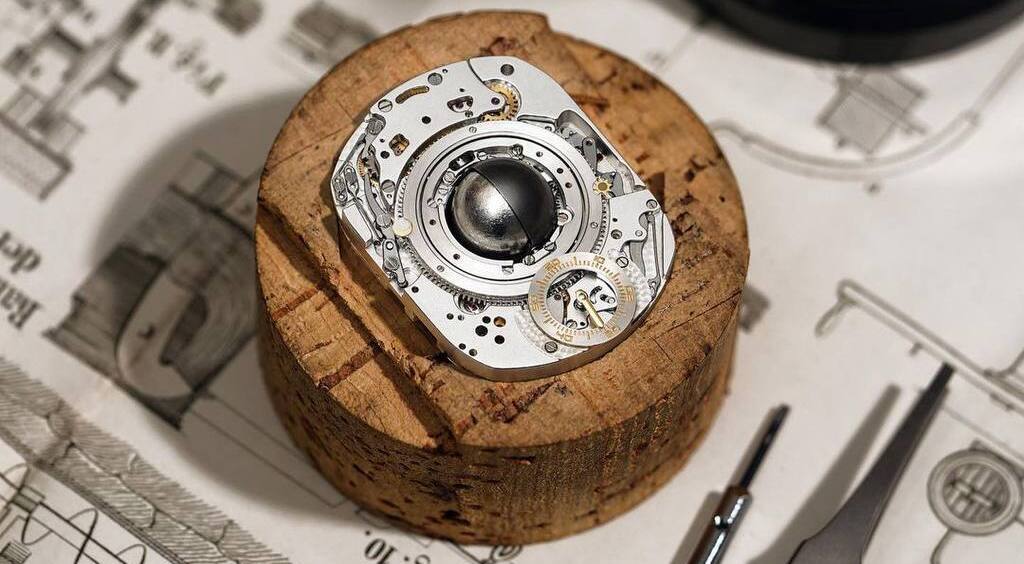
Lunokhod, 2011. The first model in Konstantin Chaykin’s Space Program, featuring his patented spherical moon-phase display
Konstantin Chaykin’s Space Program began in 2011 with the Lunokhod. Its next major focus – Mars – emerged almost by chance. One day, while walking through the manufacture, Chaykin overheard one of his employees listening to a talk by Elon Musk. Musk spoke so convincingly about travel to the Red Planet that a human landing there no longer seemed a matter for the distant future. The episode prompted Chaykin to explore Martian time and ultimately led to the creation of an entire series of original complications.
Mars Conqueror Mk1: Time on Another Planet
A Martian day is slightly longer than an Earth day: because the planet rotates somewhat more slowly on its axis, the interval between two successive noons lasts 24 hours, 39 minutes and 35.244 seconds. The difference may seem negligible at first, but becomes quite noticeable after only a few days. To distinguish a Martian solar day from an Earth day, NASA began using a separate term during the Viking missions in 1976 – the sol.

The first color image of the Martian surface, taken by the Viking 1 lander on July 21, 1976
It was divided into 24 hours, each hour into 60 minutes, and each minute into 60 seconds. The familiar numbers of hours, minutes and seconds remained unchanged, but the units themselves became approximately 2.75 percent longer than their Earth equivalents. Before Konstantin Chaykin, attempts had already been made to adapt mechanical watches to the length of a Martian day by reducing the balance frequency. Such watches, however, could display either Earth time or Martian time, but not both. Chaykin set himself a more complex task – to combine the two systems within a single mechanism.
The Martian Program officially began on July 27, 2018, the day of the great opposition of Earth and Mars and a total lunar eclipse. At the Moscow Planetarium, Chaykin presented the automatic K.20-1 calibre developed for the future Mars Conqueror Mk1. A dedicated 159-component module enabled the movement to drive both Earth-time and Martian-time displays simultaneously.

Mars Conqueror Mk1, 2018. Chaykin’s first prototype with synchronized Earth-time and Martian-time displays
A patented gear train incorporating 109- and 112-tooth wheels slowed the Martian hands to match the length of a sol. The calculated error was approximately 2.7 seconds – within the accepted daily rate tolerance for a mechanical chronometer. Another patented mechanism tracked the 780-day cycle of Mars oppositions. An enhanced version reproduced the orbital motion of Earth and the Red Planet, making it possible to follow the approach of the next opposition and roughly estimate the distance between Earth and Mars. As a result, the watch combined Earth time and Martian time, a Martian calendar, and an indication of the relative positions of the two planets.
From a Complex Prototype to the Mars Conqueror Mk3
Testing of the first watch confirmed the viability of the concept while also revealing its weaknesses. Konstantin Chaykin eliminated backlash in the Martian-time gear train and refined the correction system, completing the design of the next model in the spring of 2019. The project, however, never progressed beyond the 3D-model stage: the watch was still too large, complex and expensive for production. For the third version, Chaykin therefore reconsidered the architecture of the model itself. The Mars Conqueror Mk3 retained the essential feature – simultaneous display of Earth time and Martian time – while dispensing with the planetary and calendar functions of the first prototype.
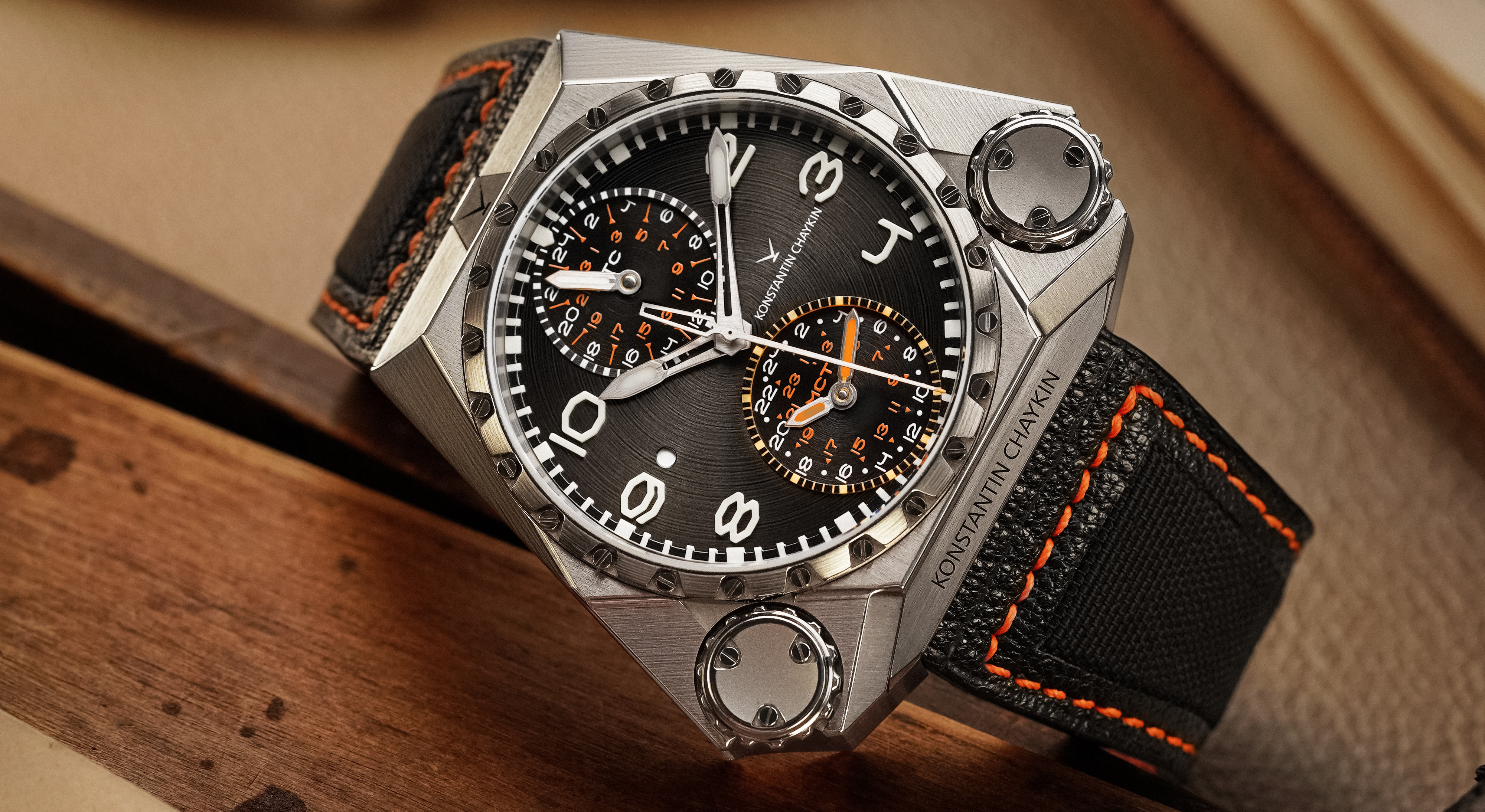
Mars Conqueror Mk3, 2020. An aviation-style model displaying local time, a second time zone, and Martian time
The new K.15-0 calibre displayed local time, a second time zone (UTC), and Martian time, with the three functions controlled by a system of two vertical crowns. Integrating this system required substantial modifications to the base movement: the standard calendar mechanism was replaced, a new gear train was added, and the case ring was incorporated into the construction of the calibre. Another proprietary development was a technology for producing monolithic luminous elements, used for the three-dimensional hour numerals and minute track. The Earth-time indications glow greenish blue, while the Martian indications glow orange. Thus, a complex experimental instrument evolved into the first Martian pilot’s watch, produced in a limited edition of eight pieces.
Martian Perpetual Calendar
For future explorers of the Red Planet, displaying Martian hours and minutes alone would not be enough. Life on Mars would also require its own calendar, aligned with the length of the local day and year. No universally accepted system yet exists, so Konstantin Chaykin turned to one of the best-known proposals – the Darian calendar. It was devised in 1985 by American aerospace engineer Thomas Gangale and named after his son Darius. In this calendar, the Martian year is divided into 24 months arranged in groups of six: the first five contain 28 sols each, while the sixth contains 27. In leap years, the final month also receives a 28th sol. As a result, the calendar year contains either 668 or 669 sols and remains aligned with Mars’s orbit around the Sun.
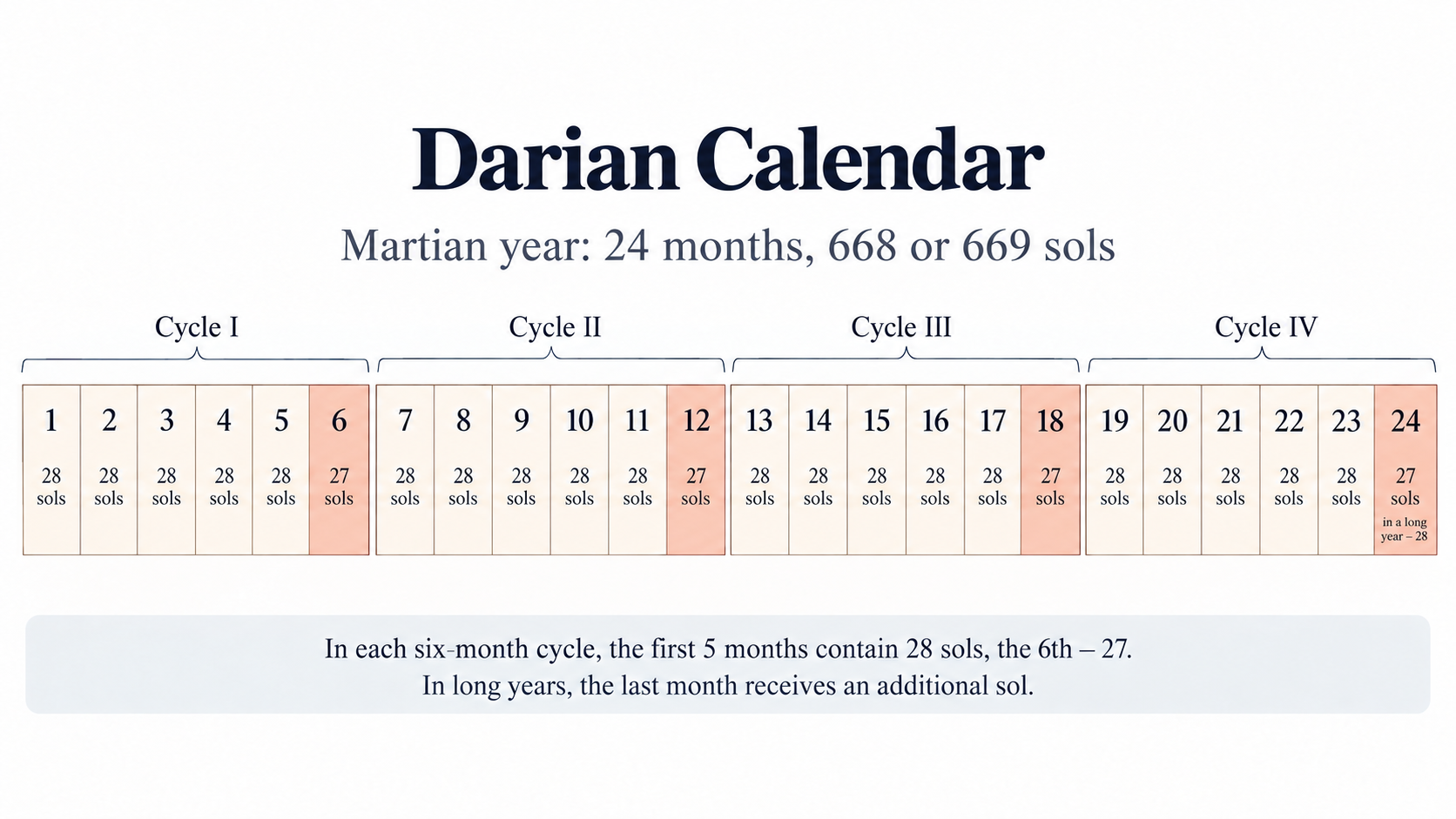 In 2020, Chaykin translated this algorithm into the language of mechanical watchmaking and patented a perpetual Martian calendar mechanism. Once per sol, the mechanism advances the date indicator, while at the end of each month a separate gear train moves the month indicator to the next of the 24 months. The calendar is controlled by two program cams. The first governs the sequence of months throughout the Martian year, while the second determines the alternation of long and short years within a ten-year cycle. A follower lever tracks their profiles and determines whether a month should end after the 27th or 28th sol. This development was intended to become part of the Magnum Opus Mars Traveller, conceived by Chaykin as the culmination of his Martian Time program.
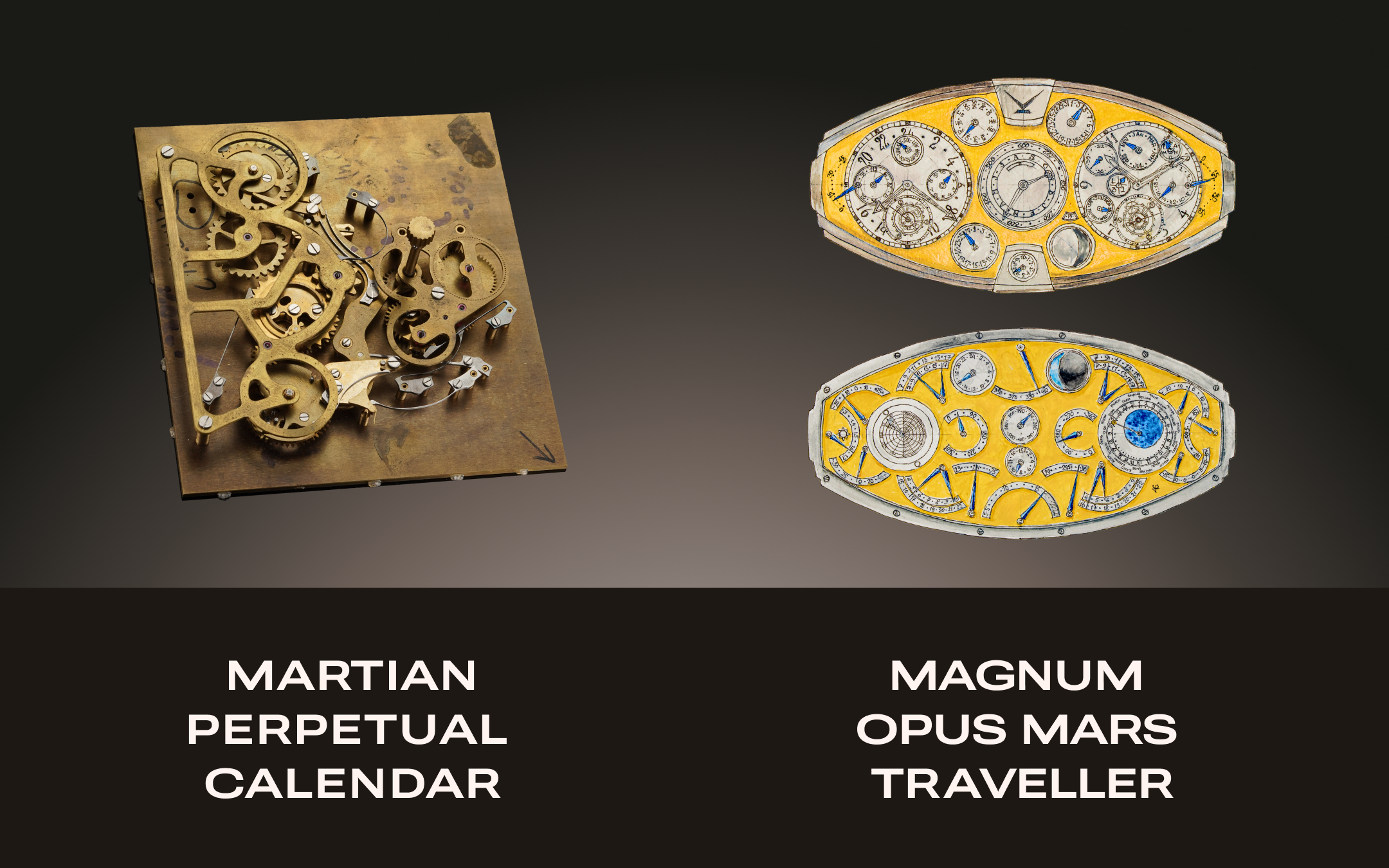
Left: Martian perpetual calendar module, 2021. A working prototype of the mechanism based on the Darian calendar system
Right: Magnum Opus Mars Traveller. Sketches of the front and reverse sides of the watch
The two sides of the watch were intended to accommodate two independent systems: an Earth system, with conventional time, a perpetual calendar and a tourbillon, and a Martian system, with its own time display, perpetual calendar and Martian tourbillon. The project remained at the stage of detailed sketches, but brought together within a single construction nearly all the key ideas of the Martian Time program.
Martian Tourbillon
In 2021, some of the ideas conceived for the Magnum Opus Mars Traveller were realized in the unique Martian Tourbillon, created for the Only Watch charity auction. Its tourbillon cage completed one revolution in 61.65 Earth seconds – exactly the length of one Martian minute. To achieve this, Chaykin recalculated the gear train and adjusted the balance to an unusual frequency of 19,270 vibrations per hour. Disc displays for the hours and minutes indicate Martian time, while the lower sector houses a calendar developed by Chaykin on the basis of the Darian system. A single hand indicates both the date and the day of the week.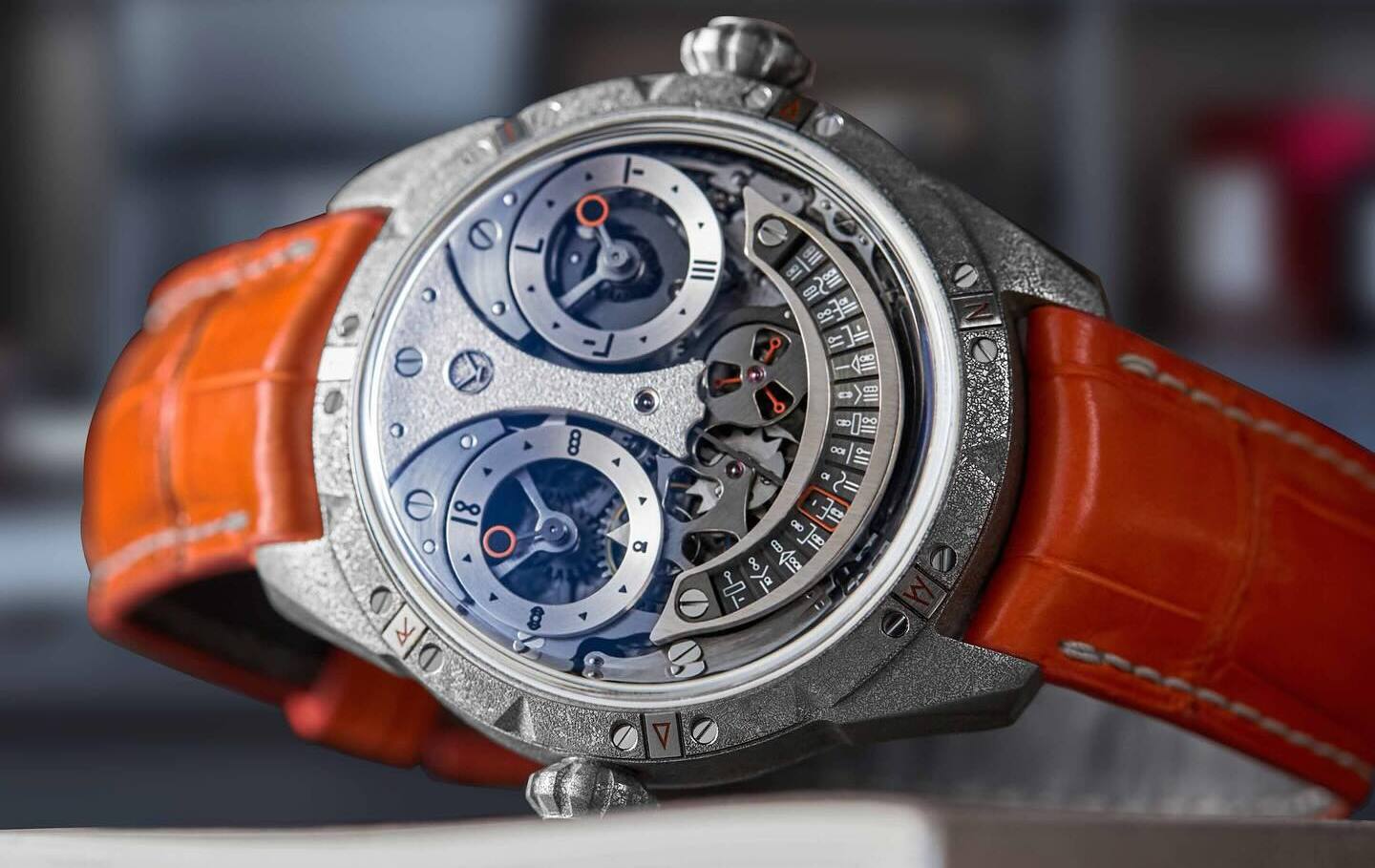
Martian Tourbillon, 2021. A unique watch with a tourbillon completing one revolution every Martian minute – 61.65 Earth seconds
The dates for the first two weeks of the month are arranged in the upper row, while those for the third and fourth weeks appear in the lower row. An additional indicator above the calendar sector shows which half of the month the current date belongs to. For the watch, Chaykin developed his own system of Martian symbols. His original numeral designs are used for the hour and minute indications and on the calendar scales, while seven geometric symbols between the two rows of dates represent the days of the week.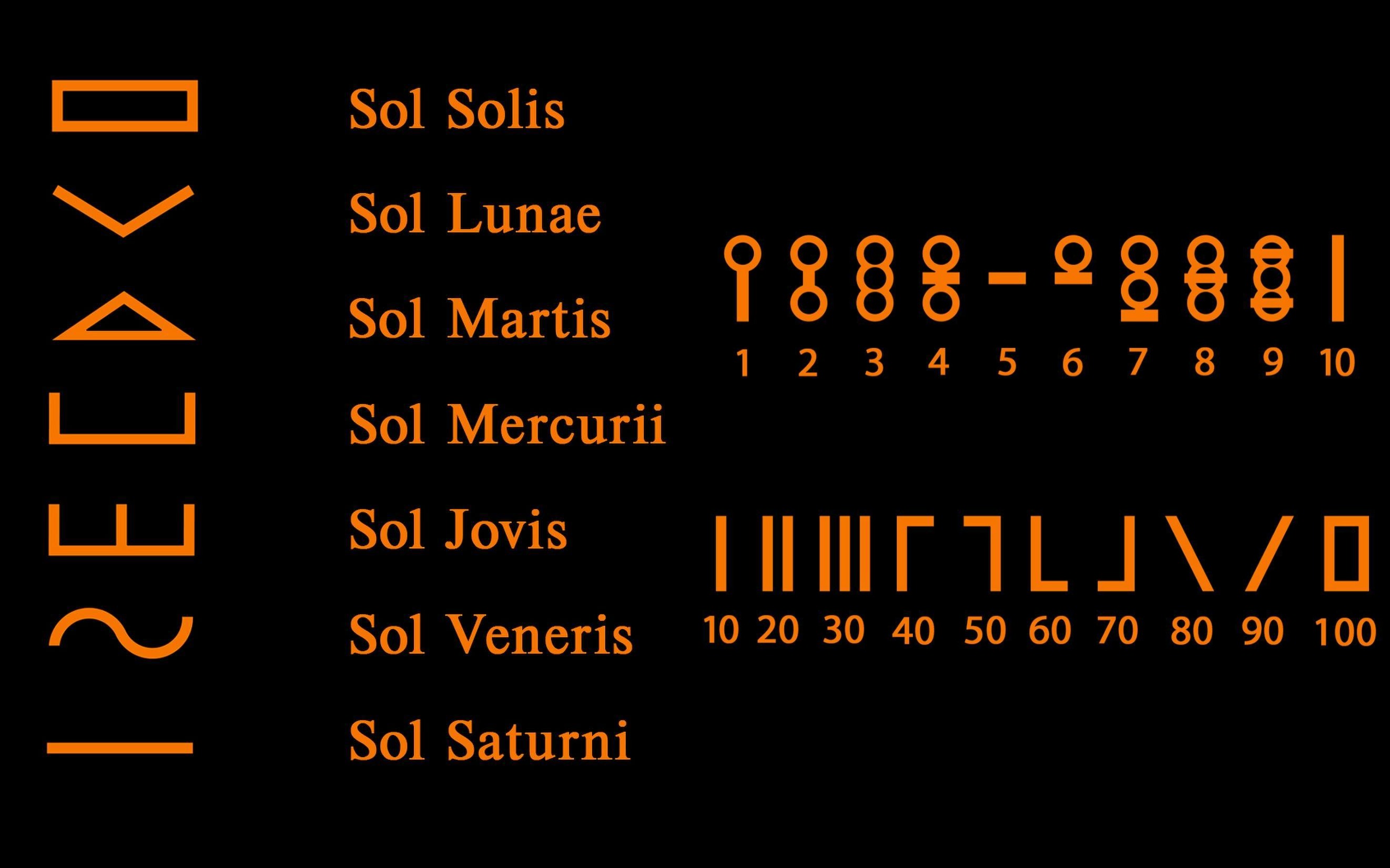 Their forms are echoed in the construction of the watch itself: the hour and minute hands resemble the Martian numeral one, while the rocking bridge of the intermediate gear train recalls the numeral three. In this way, Martian time acquired a visual language of its own.
A Mechanical Computer for Mars
In 2020–2021, Chaykin patented several devices for potential interplanetary missions: indicators for the positions of Mars, its moons Phobos and Deimos, and the Sun, as well as mechanisms for determining launch windows and the approach of major oppositions. The most complex of these developments was the Martian Calculator, designed to determine the current distance between Earth and Mars. Both planets move along elliptical orbits with different periods and variable speeds, so Chaykin had to translate complex astronomical calculations into mechanical form.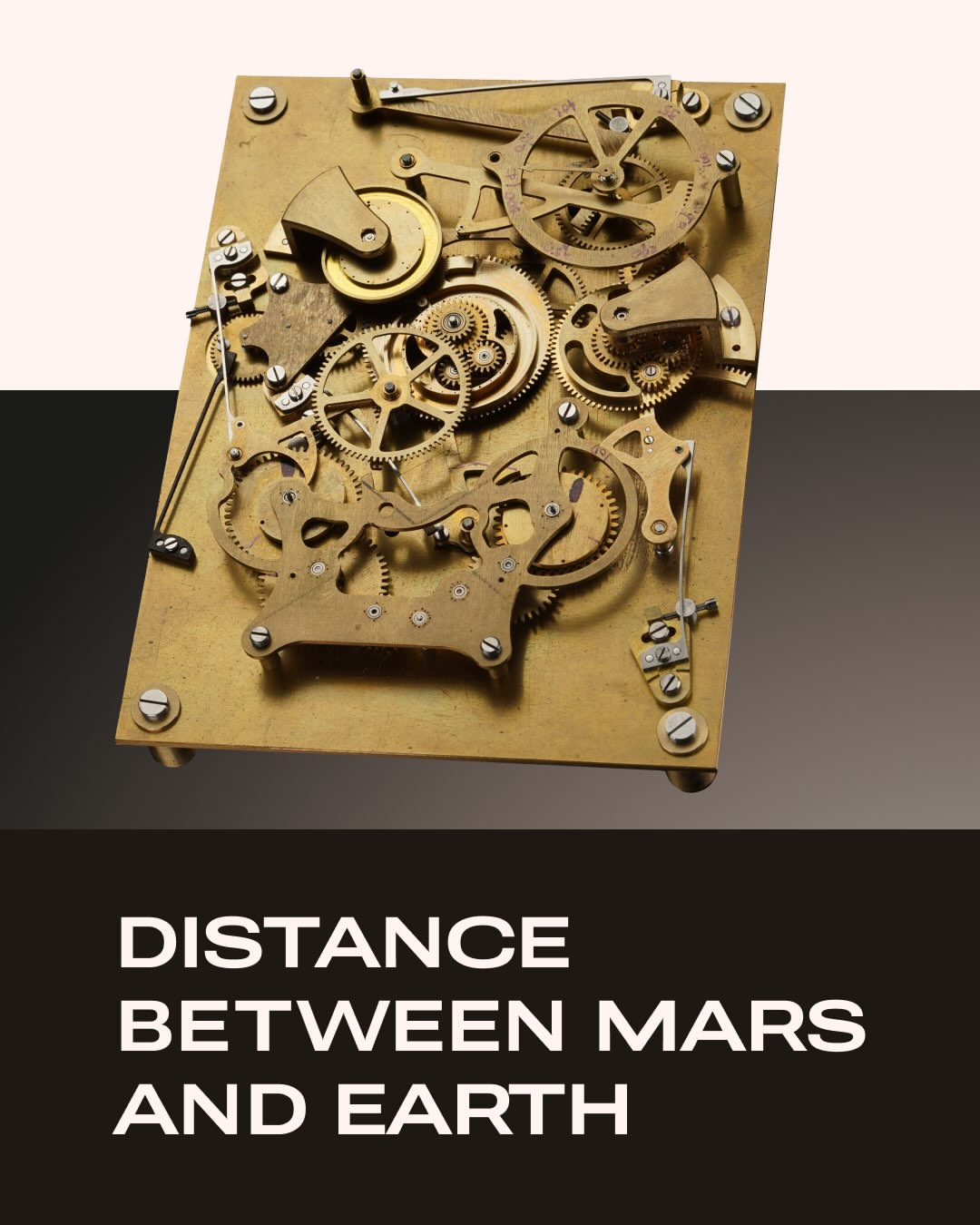 The gear trains reproduce the orbital motion of the planets, while cams account for variations in their orbital speeds. Mechanical computing units combine the resulting values and transmit the result to the distance hand. The device is protected by patent RU2759417 and exists as a working module prototype, without final finishing or a protective galvanic coating. Its underlying principle could eventually be incorporated into a wristwatch or a table clock. Chaykin himself compares the complexity of this development with that of his mechanism for determining the date of Orthodox Easter.
From Calculations to Outer Space
While Chaykin’s Martian developments are still aimed at the future, another branch of the Space Program has been evolving for years under real spaceflight conditions. The manufacture’s cooperation with Roscosmos dates back to 2018 and focuses on the development of mechanical watches for Russian cosmonauts. The work proceeds step by step: new experimental prototypes are tested on Earth, in orbit and during spacewalks, with the results feeding directly into the development of subsequent versions.
The first result of this work was the Space Conqueror. In 2021, two prototypes were delivered to the International Space Station: one was tested inside the ISS, while the other accompanied Oleg Novitsky on two spacewalks. After the watches returned to Earth, the construction was refined, including a redesign of the crystal mounting system. On August 17, 2022, the upgraded chronograph underwent another test outside the station – this time with Oleg Artemyev.

SC02C, 2026. An adapted version of the professional chronograph for Russian cosmonauts, developed using experience gained from four spacewalks
On May 7, 2026, Sergei Kud-Sverchkov and Sergei Mikaev carried the program into its next stage: next-generation chronographs attached to their Orlan-MKS spacesuits spent 6 hours and 6 minutes in outer space. Over the course of several years, Konstantin Chaykin watches have thus taken part in four spacewalks.
The current stage of this long-term program is the SC02C – an adapted version of the professional chronograph for Russian cosmonauts. Its construction incorporates solutions developed and refined on the basis of data gathered during space testing. The research program is ongoing: experience gained from terrestrial use of the model is expected to provide new data for the development of future generations of specialized watches.